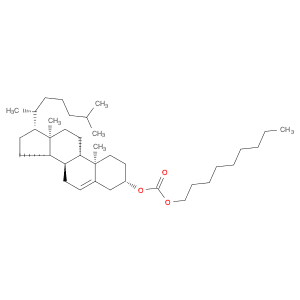
CAS 15455-83-1
:Cholesterolnonylcarbonate
Description:
Cholesterolnonylcarbonate, with the CAS number 15455-83-1, is a chemical compound that belongs to the class of carbonate esters. It is derived from cholesterol, a sterol that plays a crucial role in cellular structure and function, and nonyl alcohol, which contributes to its hydrophobic characteristics. This compound typically exhibits a hydrophobic nature due to the long nonyl chain, making it less soluble in water but more soluble in organic solvents. Cholesterolnonylcarbonate is often studied for its potential applications in pharmaceuticals and cosmetics, particularly in drug delivery systems and as an emulsifying agent. Its structure allows for interactions with biological membranes, which can enhance the permeability of certain compounds. Additionally, it may possess properties that can stabilize formulations, improve texture, and enhance the bioavailability of active ingredients. As with many chemical substances, safety and handling precautions should be observed, as the biological effects and toxicity profiles can vary based on concentration and exposure routes.
Formula:C37H64O3
InChI:InChI=1/C37H64O3/c1-7-8-9-10-11-12-13-25-39-35(38)40-30-21-23-36(5)29(26-30)17-18-31-33-20-19-32(28(4)16-14-15-27(2)3)37(33,6)24-22-34(31)36/h17,27-28,30-34H,7-16,18-26H2,1-6H3/t28-,30+,31+,32-,33+,34+,36+,37-/m1/s1
Synonyms:- Cholesterol n-nonyl carbonate
Sort by
Purity (%)
0
100
|
0
|
50
|
90
|
95
|
100
Found 3 products.
Cholesterol Nonyl Carbonate
CAS:Controlled ProductCholesterol Nonyl Carbonate is a fatty acid with a carbon chain of 12-18 carbons. It is a section, which enhances the microcapsules’ ability to adhere to surfaces and prevents them from being washed away by water. This compound can be used as a coating for inorganic materials, such as metals and polymers, and organic solvents, such as polypropylene. Cholesterol Nonyl Carbonate has functional groups that are polar, which allow it to dissolve in organic solvents and create coatings on objects. The molecule is comprised of an average particle diameter of 1 micrometer with a particle size distribution ranging from 0.5-10 micrometers. The treatment method for this compound involves thermal energy and conformational changes.END>
Purity:Min. 95%