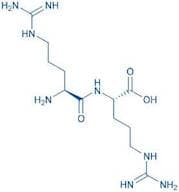
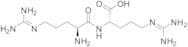
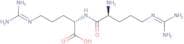
CAS 15483-27-9
:L-Arginyl-L-arginine
- 108: PN: WO2021061872 SEQID: 108 claimed protein
- 162: PN: EP2161028 PAGE: 9 claimed protein
- 1688: PN: WO2007124090 PAGE: 83 claimed protein
- 204: PN: WO2010059829 SEQID: 221 unclaimed protein
- 43: PN: WO2010045512 SEQID: 41 unclaimed protein
- 43: PN: WO2020027640 SEQID: 106 claimed protein
- 83: PN: US20090175923 SEQID: 83 unclaimed protein
- 83: PN: US20110202000 SEQID: 83 unclaimed protein
- 83: PN: WO2011149461 SEQID: 83 unclaimed protein
- 85-86-Protein TIM-1 (human fragment)
- <span class="text-smallcaps">L</smallcap>-Arginine, <smallcap>L</span>-arginyl-
- <span class="text-smallcaps">L</smallcap>-Arginine, N<sup>2</sup>-<smallcap>L</span>-arginyl-
- <span class="text-smallcaps">L</smallcap>-Arginyl-<smallcap>L</span>-arginine
- Arg-arg
- Arginine, N<sup>2</sup>-<span class="text-smallcaps">L</smallcap>-arginyl-, <smallcap>L</span>-
- Arginyl-L-arginine
- Arginylarginine
- H-Arg-Arg-Oh Acetate Salt
- L-Arginine, N2-L-arginyl-
- N~5~-(diaminomethylidene)-L-ornithyl-N~5~-(diaminomethylidene)-L-ornithine
- N~5~-(diaminomethylidene)ornithyl-N~5~-(diaminomethylidene)ornithine
- Arginine, N2-L-arginyl-, L-
- L-Arginyl-L-arginine
- See more synonyms
H-Arg-Arg-OH
CAS:Arginine-containing dipeptides as RR and RF are used by nitric oxide synthase as substrates in place of Arg.Formula:C12H26N8O3Purity:> 98%Color and Shape:White PowderMolecular weight:330.39H-Arg-Arg-OH Acetate Salt
CAS:Controlled ProductFormula:C12H26N8O3Color and Shape:NeatMolecular weight:330.387H-Arg-Arg-OH acetate salt
CAS:H-Arg-Arg-OH acetate salt is a protease inhibitor. It has been shown to inhibit the activity of serine proteases, such as trypsin and chymotrypsin, in vitro. H-Arg-Arg-OH acetate salt binds to the active site of the enzyme and prevents substrate binding. The acidity of the environment where this inhibitor is active can be used to control its activity. At acidic pH, H-Arg-Arg-OH acetate salt is more potent than at neutral pH. When it comes into contact with a protein substrate, H-Arg-Arg-OH acetate salt will bind to a hydroxyl group on the protein molecule and prevent it from hydrolyzing its substrate. This process can be reversed by adding an alkaline buffer to increase the pH of the system or by adding an acid buffer to decrease it.br>br> H-Arg-Arg-OH acetate salt is found in cyanob
Formula:C12H26N8O3Purity:Min. 95%Molecular weight:330.39 g/mol