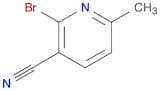
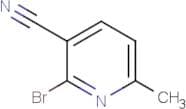
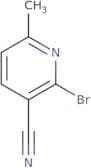
CAS 155265-57-9
:2-Bromo-3-cyano-6-methylpyridine
Description:
2-Bromo-3-cyano-6-methylpyridine is a heterocyclic organic compound characterized by a pyridine ring substituted with a bromine atom, a cyano group, and a methyl group. The presence of the bromine atom introduces significant reactivity, making it useful in various synthetic applications, particularly in medicinal chemistry and agrochemicals. The cyano group contributes to the compound's polarity and can participate in nucleophilic reactions, while the methyl group influences the compound's steric and electronic properties. This compound typically appears as a solid at room temperature and is soluble in polar organic solvents. Its molecular structure allows for potential interactions with biological targets, making it of interest in drug discovery. Additionally, the compound's stability under standard conditions and its ability to undergo further chemical transformations enhance its utility in organic synthesis. Safety precautions should be taken when handling this compound due to the presence of bromine, which can be hazardous. Overall, 2-Bromo-3-cyano-6-methylpyridine is a versatile building block in organic synthesis and pharmaceutical development.
Formula:C7H5BrN2
Sort by
Purity (%)
0
100
|
0
|
50
|
90
|
95
|
100
Found 4 products.
3-Pyridinecarbonitrile, 2-bromo-6-methyl-
CAS:Formula:C7H5BrN2Purity:96%Color and Shape:SolidMolecular weight:197.03202-Bromo-6-methylnicotinonitrile
CAS:2-Bromo-6-methylnicotinonitrilePurity:97%Molecular weight:197.03g/mol2-Bromo-6-methylnicotinonitrile
CAS:2-Bromo-6-methylnicotinonitrile is a reactive heterocyclic compound that has been used as a palladium catalyst. It undergoes substitution reactions with halides and polyhalogenated compounds. The yield of this reaction depends on the substituents and functional groups present. 2-Bromo-6-methylnicotinonitrile can also be used to form alkynes, alkynes, and heterocycles. 2-Bromo-6-methylnicotinonitrile is an alkyne that has two functional groups: a nitrile group and a bromine group. It reacts with nucleophiles such as ammonia or amines to form the corresponding amide or amine in good yields.Formula:C7H5BrN2Purity:Min. 95%Molecular weight:197.03 g/mol