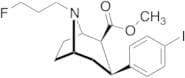
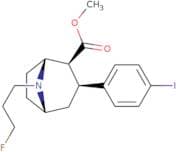
![8-AZABICYCLO[3.2.1]OCTANE-2-CARBOXYLIC ACID, 8-(3-FLUOROPROPYL)-3-(4-IODOPHENYL)-, METHYL ESTER (1…](/_next/image/?url=https%3A%2Fstatic.cymitquimica.com%2Fcas-image%2Fthumb-webp%2F311860-8-azabicyclo-3-2-1-octane-2-carboxylic-acid-8-3-fluoropropyl-3-4-iodophenyl-methyl-ester-1r-2s-3s-5s.webp&w=3840&q=75)
CAS 155797-99-2
:8-AZABICYCLO[3.2.1]OCTANE-2-CARBOXYLIC ACID, 8-(3-FLUOROPROPYL)-3-(4-IODOPHENYL)-, METHYL ESTER (1R,2S,3S,5S)-
Description:
8-Azabicyclo[3.2.1]octane-2-carboxylic acid, 8-(3-fluoropropyl)-3-(4-iodophenyl)-, methyl ester, with the CAS number 155797-99-2, is a complex organic compound characterized by its bicyclic structure, which includes a nitrogen atom in the ring system. This compound features a carboxylic acid functional group, which is esterified to form a methyl ester, enhancing its solubility and reactivity. The presence of a fluoropropyl group and a 4-iodophenyl substituent contributes to its unique chemical properties, potentially influencing its biological activity and interaction with other molecules. The stereochemistry indicated by the (1R,2S,3S,5S) configuration suggests specific spatial arrangements of its atoms, which can significantly affect its pharmacological profile. Such compounds are often studied for their potential applications in medicinal chemistry, particularly in the development of pharmaceuticals targeting various biological pathways. Overall, this compound exemplifies the intricate relationship between molecular structure and function in organic chemistry.
Formula:C18H23FINO2
InChI:InChI=1/C18H23FINO2/c1-23-18(22)17-15(12-3-5-13(20)6-4-12)11-14-7-8-16(17)21(14)10-2-9-19/h3-6,14-17H,2,7-11H2,1H3/t14?,15-,16+,17+/m1/s1
Synonyms:- Beta-Cit-Fp
- Citfp
- Rti 313
- N-2-Fluoropropyl-3-Beta-(4-Iodophenyl)Nortropane-2-Beta-Carboxylic Acid Methyl Ester
- 2-Carbomethoxy-8-(3-Fluoropropyl)-3-(4-Iodophenyl)Tropane
- CITFP, beta-CIT-FP
- methyl (1S,2S,3S)-8-(3-fluoropropyl)-3-(4-iodophenyl)-8-azabicyclo[3.2.1]octane-2-carboxylate
- 8-Azabicyclo[3.2.1]octane-2-carboxylic acid, 8-(3-fluoropropyl)-3-(4-iodophenyl)-, methyl ester, (1R,2S,3S,5S)-
Sort by
Purity (%)
0
100
|
0
|
50
|
90
|
95
|
100
Found 2 products.
Beta-CIT-FP
CAS:Controlled ProductMethyl (1R,2S,3S)-8-(3-Fluoropropyl)-3-(4-Iodophenyl)-8-Azabicyclo[3.2.1]Octane-2-Carboxylate is a potent dopamine receptor agonist with a high affinity for the D2 and D3 receptors in the brain. It has been shown to have antiparkinsonian effects in animal models of Parkinson's disease by increasing dopamine levels in the prefrontal cortex and striatum. This drug has also been shown to be effective in clinical studies for the diagnosis of Parkinson's disease. Methyl (1R,2S,3S)-8-(3-Fluoropropyl)-3-(4-Iodophenyl)-8-Azabicyclo[3.2.1]Octane-2-Carboxylate binds to both dopamine and serotonin receptors, which may account for its therapeutic effects on ParkinsonFormula:C18H23FINO2Purity:Min. 95%Molecular weight:431.28 g/mol