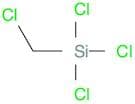
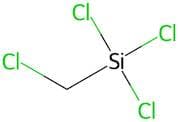
CAS 1558-25-4
:Trichloro(chloromethyl)silane
- (Chloromethyl)Trichlorosilane
- Ls 30
- NSC 139830
- Silane, trichloro(chloromethyl)-
- Trichloro(chloromethyl)silane
Chloromethyltrichlorosilane
CAS:Formula:CH2Cl4SiPurity:97%Color and Shape:LiquidMolecular weight:183.9241(Chloromethyl)trichlorosilane
CAS:(Chloromethyl)trichlorosilanePurity:98%Molecular weight:183.92g/molCHLOROMETHYLTRICHLOROSILANE
CAS:Halogen Functional Trichloro Silane
Silane coupling agents have the ability to form a durable bond between organic and inorganic materials to generate desired heterogeneous environments or to incorporate the bulk properties of different phases into a uniform composite structure. The general formula has two classes of functionality. The hydrolyzable group forms stable condensation products with siliceous surfaces and other oxides such as those of aluminum, zirconium, tin, titanium, and nickel. The organofunctional group alters the wetting or adhesion characteristics of the substrate, utilizes the substrate to catalyze chemical transformations at the heterogeneous interface, orders the interfacial region, or modifies its partition characteristics, and significantly effects the covalent bond between organic and inorganic materials.
(Trichlorosilyl)chloromethane; Chloromethyltrichlorosilane
Viscosity, 20 °: 0.5 cStVapor pressure, 20 °C: 18 mmThermal conductivity, 27°C: 0.1420 W/m°CHeat capacity, 27°C: 0.912 kJ/kg°CΔHvap: 157.8 kJ/moleDipole moment: 1.61 debyeSurface tension, 27 °C: 26.5 mN/mCritical temperature: 310 °CAutoignition temperature: 380 °CBuilding block for carbosilanesDecomposes at temperatures >250 °CGrignard reagent behaves as nucleophilic hydroxymethylation agentForms stable Grignard reagent that after reaction and oxidation transfers a hydroxymethyl moietyGenerates HCl as a hydrolysis byproductFormula:CH2Cl4SiPurity:97%Color and Shape:Straw LiquidMolecular weight:183.92