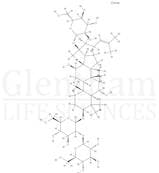
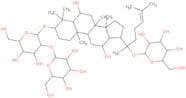
CAS 156009-80-2
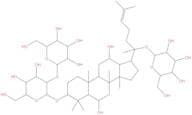
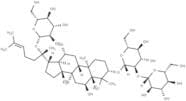
:b-D-Glucopyranoside, (3b,6a,12b)-20-(b-D-glucopyranosyloxy)-6,12-dihydroxydammar-24-en-3-yl2-O-b-D-glucopyranosyl-
Description:
The chemical substance known as b-D-Glucopyranoside, specifically the compound with the designation (3b,6a,12b)-20-(b-D-glucopyranosyloxy)-6,12-dihydroxydammar-24-en-3-yl 2-O-b-D-glucopyranosyl-, is a complex glycoside derived from a dammarane-type triterpene. It features multiple glucopyranosyl moieties, which are sugar units that enhance its solubility and biological activity. The presence of hydroxyl groups contributes to its potential reactivity and interaction with biological systems. This compound is notable for its structural complexity, which may influence its pharmacological properties, including potential anti-inflammatory or antioxidant activities. The molecular structure suggests that it may play a role in plant defense mechanisms or have applications in traditional medicine. Its CAS number, 156009-80-2, allows for precise identification in chemical databases, facilitating research and development in various fields, including pharmacognosy and natural product chemistry. Overall, this compound exemplifies the intricate relationship between structure and function in bioactive natural products.
Formula:C48H82O19
Synonyms:- Dammarane,b-D-glucopyranoside deriv.
- VinaginsenosideR4
Sort by
Purity (%)
0
100
|
0
|
50
|
90
|
95
|
100
Found 6 products.
β-D-Glucopyranoside, (3β,6α,12β)-20-(β-D-glucopyranosyloxy)-6,12-dihydroxydammar-24-en-3-yl 2-O-β-D-glucopyranosyl-
CAS:Formula:C48H82O19Purity:99%Molecular weight:963.1533Vinaginsenoside R4
CAS:Vinaginsenoside R4 from hydroponic ginseng leaves may be a non-toxic skin whitener, inhibiting melanin and coloring zebrafish.Formula:C48H82O19Purity:99.83% - 99.92%Color and Shape:SolidMolecular weight:963.15Ref: TM-TN2296
1mg152.00€5mg409.00€10mg590.00€25mg888.00€50mg1,224.00€100mg1,648.00€1mL*10mM (DMSO)354.00€vina-ginsenoside R4
CAS:Vina-ginsenoside R4 is a ginsenoside derivative, which is a naturally occurring compound found in Panax ginseng. As a bioactive saponin, its potential therapeutic effects arise from its complex structure, which interacts intricately with various cellular pathways. It is thought to exert influence by modulating inflammatory responses, enhancing neuronal protection, and potentially affecting cellular oxidative stress. The mode of action primarily involves the regulation of signaling pathways associated with immune modulation and antioxidative mechanisms. These interactions make it a subject of interest for research in pharmacology and therapeutics.Formula:C48H82O19Purity:Min. 95%Molecular weight:963.17 g/mol