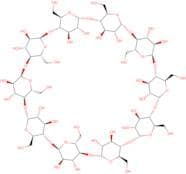
CAS 156510-98-4
:(1S,3R,5R,6S,8R,10R,11S,13R,15R,16S,18R,20R,21S,23R,25R,26S,28R,30R,31S,33R,35R,36S,38R,40R,41S,43R,45R,46S,48R,50R,51R,52R,53R,54R,55R,56R,57R,58R,59R,60R,61R,62R,63R,64R,65R,66R,67R,68R,69R,70R)-5,10,15,20,25,30,35,40,45,50-decakis(hydroxymethyl)-2,4,7,
Description:
The chemical substance with the name specified and CAS number 156510-98-4 is a complex organic compound characterized by a highly intricate stereochemistry, indicated by its extensive chiral centers. This compound features multiple hydroxymethyl groups, which suggest it may exhibit significant hydrophilicity and potential for hydrogen bonding, influencing its solubility and reactivity. The presence of numerous stereogenic centers implies that it may exist in various stereoisomeric forms, which can affect its biological activity and interactions with other molecules. Such compounds often play roles in biological systems, potentially serving as signaling molecules or structural components. The complexity of its structure may also suggest potential applications in pharmaceuticals or materials science, where specific stereochemistry can be crucial for function. Additionally, the molecular weight and overall size of the compound may influence its physical properties, such as melting point, boiling point, and viscosity, which are important for understanding its behavior in different environments.
Formula:C60H100O50
InChI:InChI=1/C60H100O50/c61-1-11-41-21(71)31(81)51(91-11)102-42-12(2-62)93-53(33(83)23(42)73)104-44-14(4-64)95-55(35(85)25(44)75)106-46-16(6-66)97-57(37(87)27(46)77)108-48-18(8-68)99-59(39(89)29(48)79)110-50-20(10-70)100-60(40(90)30(50)80)109-49-19(9-69)98-58(38(88)28(49)78)107-47-17(7-67)96-56(36(86)26(47)76)105-45-15(5-65)94-54(34(84)24(45)74)103-43-13(3-63)92-52(101-41)32(82)22(43)72/h11-90H,1-10H2/t11-,12-,13-,14-,15-,16-,17-,18-,19-,20-,21-,22-,23-,24-,25-,26-,27-,28-,29-,30-,31-,32-,33-,34-,35-,36-,37-,38-,39-,40-,41-,42-,43-,44-,45-,46-,47-,48-,49-,50-,51-,52-,53-,54-,55-,56-,57-,58-,59-,60-/m1/s1
SMILES:C([C@@H]1[C@@H]2[C@@H]([C@H]([C@H](O1)O[C@@H]1[C@@H](CO)O[C@@H]([C@@H]([C@H]1O)O)O[C@@H]1[C@@H](CO)O[C@@H]([C@@H]([C@H]1O)O)O[C@@H]1[C@@H](CO)O[C@@H]([C@@H]([C@H]1O)O)O[C@@H]1[C@@H](CO)O[C@@H]([C@@H]([C@H]1O)O)O[C@@H]1[C@@H](CO)O[C@@H]([C@@H]([C@H]1O)O)O[C@@H]1[C@@H](CO)O[C@@H]([C@@H]([C@H]1O)O)O[C@@H]1[C@@H](CO)O[C@@H]([C@@H]([C@H]1O)O)O[C@@H]1[C@@H](CO)O[C@@H]([C@@H]([C@H]1O)O)O[C@@H]1[C@@H](CO)O[C@@H]([C@@H]([C@H]1O)O)O2)O)O)O
Sort by
Purity (%)
0
100
|
0
|
50
|
90
|
95
|
100
Found 1 products.
ε-Cyclodextrin
CAS:Epsilon-cyclodextrin (ε-CD) consists of 10 glucose units. Its larger cavity size offers potential for encapsulating larger guest molecules or forming more complex inclusion compounds.
Formula:C60H100O50Purity:Min. 95%Molecular weight:1,621.41 g/mol