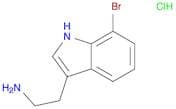
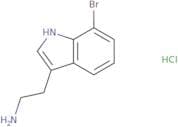
CAS 156941-60-5
:2-(7-bromo-1H-indol-3-yl)ethanamine hydrochloride
Description:
2-(7-bromo-1H-indol-3-yl)ethanamine hydrochloride is a chemical compound characterized by its indole structure, which is a bicyclic compound consisting of a benzene ring fused to a pyrrole ring. The presence of a bromine atom at the 7-position of the indole ring enhances its reactivity and may influence its biological activity. The ethanamine moiety indicates that it contains an ethylamine functional group, which contributes to its potential as a neurotransmitter or pharmacological agent. As a hydrochloride salt, it is typically more soluble in water, facilitating its use in various applications, including research in medicinal chemistry and pharmacology. The compound may exhibit properties such as being a potential ligand for certain receptors or enzymes, and its brominated indole structure may impart unique interactions in biological systems. Safety data and handling precautions should be observed due to the presence of bromine, which can be hazardous. Overall, this compound is of interest for its potential applications in drug development and biological research.
Formula:C10H12BrClN2
InChI:InChI=1/C10H11BrN2.ClH/c11-9-3-1-2-8-7(4-5-12)6-13-10(8)9;/h1-3,6,13H,4-5,12H2;1H
SMILES:c1cc2c(CCN)c[nH]c2c(c1)Br.Cl
Synonyms:- 1H-indole-3-ethanamine, 7-bromo-, hydrochloride (1:1)
- 2-(7-Bromo-1H-indol-3-yl)ethanamine hydrochloride (1:1)
Sort by
Purity (%)
0
100
|
0
|
50
|
90
|
95
|
100
Found 2 products.
2-(7-Bromo-1h-indol-3-yl)ethanamine, HCl
CAS:Formula:C10H12BrClN2Purity:98%Color and Shape:SolidMolecular weight:275.57272-(7-Bromo-1H-indol-3-yl)ethanamine hydrochloride
CAS:Controlled Product2-(7-Bromo-1H-indol-3-yl)ethanamine hydrochloride is an organic chemical compound that belongs to the group of versatile building blocks. It is a colorless solid and has a melting point of 160°C. 2-(7-Bromo-1H-indol-3-yl)ethanamine hydrochloride can be used as a research chemical, reagent, or specialty chemical. This compound is a useful building block for the synthesis of complex compounds and can be used as a reaction component in the synthesis of useful scaffolds.Formula:C10H12BrClN2Purity:Min. 95%Color and Shape:PowderMolecular weight:275.57 g/mol