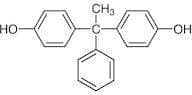
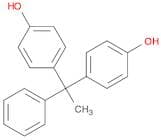
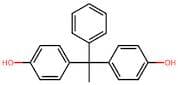
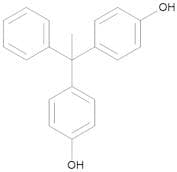
CAS 1571-75-1
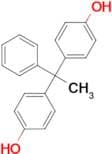
:1,1-Bis(4-hydroxyphenyl)-1-phenylethane
- 1,1-Bis(4-hydroxyphenyl)-1-phenylethane
- 1-Phenyl-1,1-bis(4-hydroxyphenyl)ethane
- 4,4'-(1-Phenylethane-1,1-Diyl)Diphenol
- 4,4'-(1-Phenylethylidene) Biphenol
- 4,4-(1-alpha-Methylbenzylidene)bisphenol
- 4,4′-(1-Phenylethylidene)bis[phenol]
- 4,4′-(1-Phenylethylidene)diphenol
- 4,4′-(α-Methylbenzylidene)diphenol
- Bis(4-hydroxyphenyl)methylphenylmethane
- Bisp-Ap
- Bisphenol ACP
- Bisphenol AP
- Nk-Ap
- Phenol, 4,4′-(1-phenylethylidene)bis-
- Phenol, 4,4′-(α-methylbenzylidene)di-
- See more synonyms
4,4'-(α-Methylbenzylidene)bisphenol
CAS:Formula:C20H18O2Purity:>98.0%(HPLC)Color and Shape:White to Almost white powder to crystalMolecular weight:290.36Phenol, 4,4'-(1-phenylethylidene)bis-
CAS:Formula:C20H18O2Purity:95%Color and Shape:SolidMolecular weight:290.35574,4'-(1-Phenylethylidene) biphenol
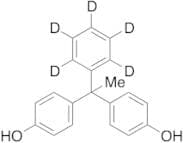
CAS:4,4'-(1-Phenylethylidene) biphenolPurity:98%Molecular weight:290.36g/molBisphenol AP-d5
CAS:Controlled ProductApplications Bisphenol AP-d5 is the isotope labelled analog of Bisphenol AP. Bisphenol AP is used to prepare triphenylmethane derivatives as inhibitors of hepatitis C virus helicase. It is a derivative of Bisphenol A (B519495) which is a monomer used for policarbonate and epoxy resins.
References Chen, C., et al.: J. Med. Chem., 52, 2716 (2009); Krishnan, A.V., et al.: Endocrinology, 132, 2279 (1993); Steinmetz, R., et al.: Trends Endocrinol. Metab., 9, 124 (1998); Petersen, H., et al.: Eur. Food Res. Technol., 216, 355 (2003)Formula:C20H13D5O2Color and Shape:NeatMolecular weight:295.39Bisphenol AP-13C6
CAS:Controlled ProductApplications Bisphenol AP-13C6 is the isotope labelled analog of Bisphenol AP. Bisphenol AP is used to prepare triphenylmethane derivatives as inhibitors of hepatitis C virus helicase. It is a derivative of Bisphenol A (B519495) which is a monomer used for policarbonate and epoxy resins.
References Chen, C., et al.: J. Med. Chem., 52, 2716 (2009); Krishnan, A.V., et al.: Endocrinology, 132, 2279 (1993); Steinmetz, R., et al.: Trends Endocrinol. Metab., 9, 124 (1998); Petersen, H., et al.: Eur. Food Res. Technol., 216, 355 (2003)Formula:C1413C6H18O2Color and Shape:NeatMolecular weight:296.31Ref: 10-F226043
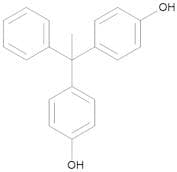
5gTo inquire10gTo inquire25gTo inquire50gTo inquire200gTo inquire100g58.00€500g212.00€1kg376.00€Bisphenol AP
CAS:Controlled ProductApplications Bisphenol AP is used to prepare triphenylmethane derivatives as inhibitors of hepatitis C virus helicase. It is a derivative of Bisphenol A (B519495) which is a monomer used for policarbonate and epoxy resins.
References Chen, C., et al.: J. Med. Chem., 52, 2716 (2009); Krishnan, A.V., et al.: Endocrinology, 132, 2279 (1993); Steinmetz, R., et al.: Trends Endocrinol. Metab., 9, 124 (1998); Petersen, H., et al.: Eur. Food Res. Technol., 216, 355 (2003);Formula:C20H18O2Color and Shape:NeatMolecular weight:290.36