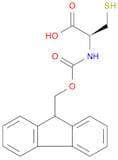
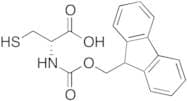
CAS 157355-80-1
:Fmoc-D-Cys-OH・H2O
Description:
Fmoc-D-Cys-OH·H2O, with the CAS number 157355-80-1, is a chemical compound that serves as a protected form of the amino acid cysteine. The "Fmoc" (9-fluorenylmethoxycarbonyl) group is a common protecting group used in peptide synthesis, allowing for selective reactions without interfering with the amino acid's functional groups. The "D" indicates that the cysteine is in its D-enantiomer form, which is less common than the L-enantiomer typically found in proteins. The presence of water in the formula suggests that the compound is often encountered in a hydrated form. Fmoc-D-Cys-OH·H2O is characterized by its ability to participate in peptide bond formation while maintaining the thiol group of cysteine, which is crucial for forming disulfide bonds in proteins. This compound is utilized in various biochemical applications, including peptide synthesis and studies involving protein structure and function. Its stability and reactivity make it a valuable tool in organic and medicinal chemistry.
Sort by
Purity (%)
0
100
|
0
|
50
|
90
|
95
|
100
Found 3 products.
Fmoc-D-cysteine hydrate
CAS:Formula:C18H19NO5SPurity:98.0%Color and Shape:SolidMolecular weight:361.41N-Fmoc-D-cysteine
CAS:Controlled Product<p>Applications N-Fmoc-D-cysteine is an N-Fmoc-protected form of D-Cysteine (C995020). D-Cysteine is a strong inhibitor of Escherichia coli growth and also functions to provide inorganic sulfates for the sulfation of xenobiotics. D-Cysteine is a non-physiological isomer of L-Cysteine (C995000), and is not involved in protein or glutathione synthesis.<br>References Glazenburg, E., et al.: Biochem. Pharm., 33, 625 (1984); Klassen, C. & Boles, J.: FASEB J., 11, 404 (1997); Soutourina, J., et al.: J. Biol. Chem., 276, 40864 (2001);<br></p>Formula:C18H17NO4SColor and Shape:NeatMolecular weight:343.4