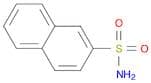
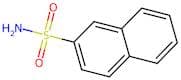
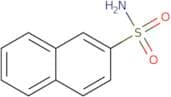
CAS 1576-47-2
:Naphthalene-2-sulphonamide
Description:
Naphthalene-2-sulphonamide, with the CAS number 1576-47-2, is an organic compound characterized by the presence of a naphthalene ring substituted with a sulfonamide group. This compound typically appears as a white to off-white crystalline solid and is known for its relatively low solubility in water, while being more soluble in organic solvents. Naphthalene-2-sulphonamide exhibits properties that make it useful in various applications, including as a reagent in organic synthesis and as an intermediate in the production of dyes and pharmaceuticals. The sulfonamide functional group imparts certain biological activities, which can be leveraged in medicinal chemistry. Additionally, naphthalene derivatives are often studied for their potential in materials science due to their unique electronic properties. Safety considerations should be taken into account when handling this compound, as it may pose health risks if inhaled or ingested. Overall, naphthalene-2-sulphonamide is a versatile compound with significant relevance in both industrial and research contexts.
Formula:C10H9NO2S
InChI:InChI=1/C10H9NO2S/c11-14(12,13)10-6-5-8-3-1-2-4-9(8)7-10/h1-7H,(H2,11,12,13)
SMILES:c1ccc2cc(ccc2c1)S(=O)(=O)N
Synonyms:- 2-Naphthalenesulfonamide
- Naphthalene-2-Sulfonamide
- NAPHTHALENE-2-SULPHONAMIDE
- Naphthalene-2-sulfonic acid amide
- NAPHTHALENE-2-SULFONAMIDE, 97 %
Sort by
Purity (%)
0
100
|
0
|
50
|
90
|
95
|
100
Found 4 products.
2-Naphthalenesulfonamide
CAS:Formula:C10H9NO2SPurity:97%Color and Shape:SolidMolecular weight:207.2490Naphthalene-2-sulfonamide
CAS:Naphthalene-2-sulfonamide is a radical scavenger that has been shown to have antioxidant activity in the presence of peroxyl radicals. In vitro experimentation has shown that naphthalene-2-sulfonamide is capable of inhibiting butyrylcholinesterase, an enzyme responsible for breaking down acetylcholine, thereby increasing the levels of this neurotransmitter. This drug may be useful as a treatment for Alzheimer's disease, as it reduces the rate of plaque formation in the brain and slows down the progression of dementia. The optimum temperature range for sedimentation is between 20 and 30 degrees Celsius.
Formula:C10H9NO2SPurity:Min. 95%Molecular weight:207.25 g/mol