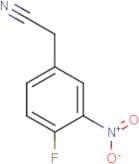
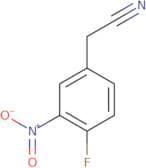
CAS 157662-77-6
:(4-fluoro-3-nitrophenyl)acetonitrile
Description:
(4-Fluoro-3-nitrophenyl)acetonitrile, with the CAS number 157662-77-6, is an organic compound characterized by its aromatic structure and the presence of both a fluoro and a nitro substituent on the phenyl ring. This compound features a nitrile functional group (-C≡N) attached to an acetic acid derivative, which contributes to its reactivity and potential applications in organic synthesis. The presence of the fluorine atom typically enhances the compound's lipophilicity and may influence its electronic properties, while the nitro group can serve as a strong electron-withdrawing group, affecting the compound's reactivity in electrophilic aromatic substitution reactions. (4-Fluoro-3-nitrophenyl)acetonitrile is likely to be a solid at room temperature and may exhibit moderate solubility in organic solvents. Its unique combination of functional groups makes it a valuable intermediate in the synthesis of pharmaceuticals and agrochemicals, as well as in materials science. Safety data should be consulted for handling and storage, as compounds with nitro groups can be sensitive and potentially hazardous.
Formula:C8H5FN2O2
InChI:InChI=1/C8H5FN2O2/c9-7-2-1-6(3-4-10)5-8(7)11(12)13/h1-2,5H,3H2
SMILES:c1cc(c(cc1CC#N)N(=O)=O)F
Synonyms:- benzeneacetonitrile, 4-fluoro-3-nitro-4-Fluoro-3-Nitrophenylacetonitrile
Sort by
Purity (%)
0
100
|
0
|
50
|
90
|
95
|
100
Found 4 products.
Benzeneacetonitrile, 4-fluoro-3-nitro-
CAS:Formula:C8H5FN2O2Purity:95%Color and Shape:SolidMolecular weight:180.13594-Fluoro-3-nitrophenylacetonitrile
CAS:<p>4-Fluoro-3-nitrophenylacetonitrile</p>Purity:95%Molecular weight:180.14g/mol4-Fluoro-3-nitrophenylacetonitrile
CAS:Formula:C8H5FN2O2Purity:97%Color and Shape:SolidMolecular weight:180.138(4-Fluoro-3-Nitrophenyl)Acetonitrile
CAS:<p>4-Fluoro-3-nitrophenylacetonitrile is a monomer that can be synthesised from the reaction of carbamic acid and diphenyl ether. It is chiral, stereoselective and nucleophilic. 4-Fluoro-3-nitrophenylacetonitrile can also be synthesised by reacting fluoroacetamide with sodium cyanide in water, forming the corresponding amide, which reacts with acetonitrile to form the nitro compound. The anti-cancer properties of 4-fluoro-3 nitrophenylacetonitrile have been studied in vitro and in vivo. This substance has been shown to inhibit growth of cancer cells and induce apoptosis. In addition, this substance has been used as a synthetic strategy for dihydroisoquinolines, which are important for their anti-cancer properties.</p>Formula:C8H5FN2O2Purity:Min. 95%Molecular weight:180.14 g/mol