CAS 15770-21-5
:Di-1H-pyrrol-2-ylmethanone
Description:
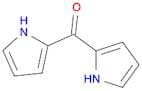
Di-1H-pyrrol-2-ylmethanone, also known by its CAS number 15770-21-5, is an organic compound characterized by the presence of two pyrrole rings attached to a central carbonyl group. This compound features a unique structure that contributes to its potential reactivity and applications in various fields, including pharmaceuticals and materials science. Pyrrole is a five-membered aromatic heterocycle, and the presence of two such rings in this compound enhances its electron-rich nature, making it a candidate for various chemical reactions, including electrophilic substitutions. The carbonyl group introduces a polar functional group, which can participate in hydrogen bonding and influence the compound's solubility and reactivity. Di-1H-pyrrol-2-ylmethanone may exhibit biological activity, making it of interest in medicinal chemistry. Its properties, such as melting point, boiling point, and solubility, would depend on the specific conditions and the presence of other functional groups or substituents. Overall, this compound represents a fascinating area of study within organic chemistry due to its structural features and potential applications.
Formula:C9H8N2O
InChI:InChI=1S/C9H8N2O/c12-9(7-3-1-5-10-7)8-4-2-6-11-8/h1-6,10-11H
InChI key:InChIKey=DKEKURXRUXRNES-UHFFFAOYSA-N
SMILES:C(=O)(C1=CC=CN1)C2=CC=CN2
Synonyms:- Pyrrol-2-yl ketone
- Dipyrrol-2-yl ketone
- Methanone, di-1H-pyrrol-2-yl-
- NSC 81355
- Di-1H-pyrrol-2-ylmethanone
Sort by
Purity (%)
0
100
|
0
|
50
|
90
|
95
|
100
Found 4 products.
Methanone, di-1H-pyrrol-2-yl-
CAS:Formula:C9H8N2OPurity:98%Color and Shape:SolidMolecular weight:160.17262-(1H-Pyrrole-2-carbonyl)-1H-pyrrole
CAS:2-(1H-Pyrrole-2-carbonyl)-1H-pyrrole is a chloride salt that inhibits the growth of tuberculosis by inhibiting the replication of bacterial DNA. It has also been shown to inhibit HIV replication in vitro. 2-(1H-Pyrrole-2-carbonyl)-1H-pyrrole is insoluble in water, so it can be dissolved in organic solvents such as carbon tetrachloride or chloroform. The solubility of this compound may be due to its ability to exist as a tautomeric pair. The geometric isomers of this compound are also possible due to its chiral center.Formula:C9H8N2OPurity:Min. 95%Molecular weight:160.17 g/mol