CAS 1578-96-7
:(1-Methyl-1H-indazol-3-yl)methanol
Description:
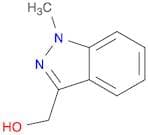
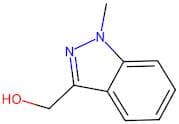
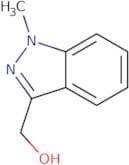
(1-Methyl-1H-indazol-3-yl)methanol, with the CAS number 1578-96-7, is an organic compound characterized by its indazole structure, which consists of a five-membered ring containing two nitrogen atoms. This compound features a methyl group attached to the indazole ring and a hydroxymethyl group (-CH2OH) that contributes to its reactivity and potential applications. It is typically a solid at room temperature and may exhibit moderate solubility in polar solvents due to the presence of the hydroxymethyl group. The compound can participate in various chemical reactions, including nucleophilic substitutions and condensation reactions, making it of interest in synthetic organic chemistry. Its unique structure may also confer biological activity, which could be explored in medicinal chemistry. As with many organic compounds, safety data should be consulted for handling and storage, as it may pose health risks if not managed properly. Overall, (1-Methyl-1H-indazol-3-yl)methanol is a versatile compound with potential applications in research and industry.
Formula:C9H10N2O
InChI:InChI=1/C9H10N2O/c1-11-9-5-3-2-4-7(9)8(6-12)10-11/h2-5,12H,6H2,1H3
SMILES:Cn1c2ccccc2c(CO)n1
Synonyms:- (1-Methylindazol-3-Yl)Methanol
- (1H-indazol-3-yl)methanol
Sort by
Purity (%)
0
100
|
0
|
50
|
90
|
95
|
100
Found 4 products.
1H-Indazole-3-methanol, 1-methyl-
CAS:Formula:C9H10N2OPurity:95%Color and Shape:LiquidMolecular weight:162.18853-(Hydroxymethyl)-1-methyl-1H-indazole
CAS:3-(Hydroxymethyl)-1-methyl-1H-indazoleFormula:C9H10N2OPurity:97%Color and Shape:LiquidMolecular weight:162.19g/mol(1-Methyl-1H-indazol-3-yl)methanol
CAS:Controlled Product(1-Methyl-1H-indazol-3-yl)methanol is a heterocyclic compound with a chemical formula of CHN. It is a colorless liquid that reacts violently with water or alcohols. The compound has been shown to form lithium aluminum hydride and aluminum hydride, which react vigorously with water. (1-Methyl-1H-indazol-3-yl)methanol also forms acetylated amines in the presence of thionyl chloride. This reaction is used as an example of a translation reaction in chemistry, where one molecule is converted into another through the addition of other molecules.Formula:C9H10N2OPurity:Min. 95%Molecular weight:162.19 g/mol