CAS 15785-26-9
:Amino-Cyclopropyl-Acetic Acid
Description:
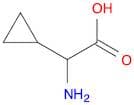
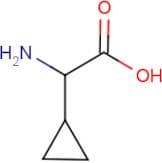
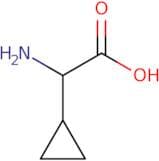
Amino-Cyclopropyl-Acetic Acid, with the CAS number 15785-26-9, is an organic compound characterized by its unique cyclopropyl structure combined with an amino and acetic acid functional group. This compound typically exhibits properties associated with both amino acids and cyclic compounds, including potential polar characteristics due to the presence of the amino group, which can engage in hydrogen bonding. The cyclopropyl ring contributes to its rigidity and may influence its reactivity and interaction with biological systems. Amino-Cyclopropyl-Acetic Acid may be of interest in pharmaceutical research due to its structural features that could mimic natural amino acids or serve as a building block in the synthesis of more complex molecules. Its solubility in water and organic solvents can vary, depending on the specific conditions and the presence of substituents. Overall, this compound's unique structure and functional groups suggest potential applications in medicinal chemistry and materials science, although specific biological activities and interactions would require further investigation.
Formula:C5H9NO2
InChI:InChI=1/C5H9NO2/c6-4(5(7)8)3-1-2-3/h3-4H,1-2,6H2,(H,7,8)
SMILES:C1CC1C(C(=O)O)N
Synonyms:- (2R)-amino(cyclopropyl)ethanoic acid
- 2-Cyclopropylglycine
Sort by
Purity (%)
0
100
|
0
|
50
|
90
|
95
|
100
Found 4 products.
Cyclopropaneacetic acid, α-amino-
CAS:Formula:C5H9NO2Purity:97%Color and Shape:SolidMolecular weight:115.13052-Cyclopropylglycine
CAS:<p>2-Cyclopropylglycine is a cyclic amino acid that is synthesized from threonine. It is an important intermediate in the biosynthesis of the aminoacyl-tRNA synthetases. The synthesis of 2-cyclopropylglycine begins with the conversion of threonine to homoserine by a series of reactions called the threonine deaminase pathway. Homoserine is converted to 3-hydroxy-2-methylvaleric acid by hydroxymethylglutaryl-CoA synthase and then to 2-cyclopropylglycine by cyclopropane carboxylic acid reductase, which reduces it to 2-cyclopropylmalonic acid, which is then converted to 2-cyclopropylglycine. This compound binds borohydride and forms an unstable complex with phenolic compounds. The affinity for these substrates depends on the pyrroline ring structure, with</p>Formula:C5H9NO2Purity:Min. 95%Molecular weight:115.13 g/mol