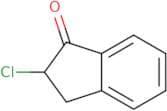
CAS 1579-14-2
:1H-Inden-1-one, 2-chloro-2,3-dihydro-
Description:
1H-Inden-1-one, 2-chloro-2,3-dihydro- (CAS 1579-14-2) is an organic compound characterized by its bicyclic structure, which includes an indene moiety and a ketone functional group. This compound features a chlorine atom at the 2-position of the dihydroindene ring, contributing to its reactivity and potential applications in organic synthesis. The presence of the carbonyl group (C=O) in the indene structure imparts unique chemical properties, making it a valuable intermediate in the synthesis of various pharmaceuticals and agrochemicals. It is typically a colorless to pale yellow liquid or solid, depending on its purity and form. The compound is known for its moderate stability under standard conditions but may undergo reactions such as nucleophilic substitution or electrophilic addition due to the presence of the chlorine atom and the carbonyl group. Safety data indicates that it should be handled with care, as it may pose health risks upon exposure. Overall, 1H-Inden-1-one, 2-chloro-2,3-dihydro- is significant in the field of organic chemistry for its versatile reactivity and potential applications.
Formula:C9H7ClO
Synonyms:- 1H-Inden-1-one, 2-chloro-2,3-dihydro-
- 2-chloro-2,3-dihydro-1H-inden-1-one
Sort by
Purity (%)
0
100
|
0
|
50
|
90
|
95
|
100
Found 1 products.
2-Chloro-2,3-dihydro-1H-inden-1-one
CAS:<p>2-Chloro-2,3-dihydro-1H-inden-1-one is a nitrogen heterocycle that can be synthesized by an asymmetric synthesis. It has been shown to inhibit the proliferation of T cells in vitro and in vivo and to suppress the development of autoimmune diseases. 2-Chloro-2,3-dihydro-1H-inden-1-one binds to a receptor on T cells and inhibits the function of this receptor. The drug was also found to be effective against trichomonas vaginalis in mice, although it has not yet been tested on humans. 2CHDI reacts with malonic acid or pyrazine carboxylic acid under acidic conditions to form a molecule with two carbonyl groups. This reaction is synergistic with hydrogen fluoride (HF) as a catalyst, which can also react with water molecules to form hydrogen gas and hydrofluoric acid.</p>Formula:C9H7ClOPurity:Min. 95%Molecular weight:166.6 g/mol