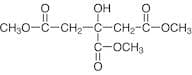
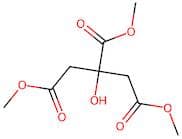
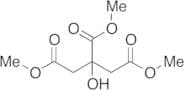
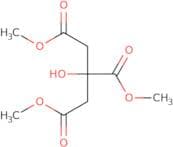
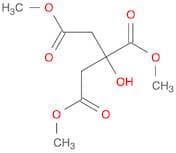
CAS 1587-20-8
:Trimethyl citrate
- 1,2,3-Propanetricarboxylic acid, 2-hydroxy-, 1,2,3-trimethyl ester
- 1,2,3-Propanetricarboxylic acid, 2-hydroxy-, trimethyl ester
- 1,2,3-Trimethyl 2-hydroxypropane-1,2,3-tricarboxylate
- 3-Hydroxy-3-methoxycarbonylpentanedioic acid dimethyl ester
- Citric acid trimethyl ester
- NSC 75824
- Trimethyl 2-Hydroxypropane-1,2,3-Tricarboxylate
- Trimethyl citrate
Trimethyl Citrate
CAS:Formula:C9H14O7Purity:>98.0%(GC)Color and Shape:White to Almost white powder to crystalMolecular weight:234.20Trimethyl 2-hydroxypropane-1,2,3-tricarboxylate
CAS:Trimethyl 2-hydroxypropane-1,2,3-tricarboxylatePurity:98%Molecular weight:234.20g/molTrimethyl Citrate
CAS:Applications Trimethyl Citrate is a reagent used in the preparation of citrate-ciprofloxacin conjugates which has antibacterial activity.
References MD-Saleh, S.R., et al.: Bioorg. Med. Chem. Lett., 19, 1496 (2009); Schmitz, F., et al.: Int. J. Antimicrob. Agents 12, 311 (1999)Formula:C9H14O7Color and Shape:White To Off-WhiteMolecular weight:234.2Trimethyl citrate
CAS:Trimethyl citrate is a fatty acid that is soluble in water, with a melting point of about 30 degrees Celsius. It is used as a biocompatible polymer for medical applications, including the treatment of metabolic disorders. Trimethyl citrate has been shown to inhibit the production of s-phenylmercapturic acid, which is produced when the body breaks down phenol compounds such as benzene and toluene. This inhibition may be due to trimethyl citrate's ability to form hydrogen bonds with the hydroxyl group on s-phenylmercapturic acid. Trimethyl citrate also inhibits hydrochloric acid-induced skin cell death by forming intramolecular hydrogen bonds with the hydroxyl group on hydrochloric acid molecules.
Formula:C9H14O7Purity:Min. 98%Color and Shape:PowderMolecular weight:234.2 g/mol1,2,3-Propanetricarboxylic acid, 2-hydroxy-, 1,2,3-trimethyl ester
CAS:Formula:C9H14O7Color and Shape:SolidMolecular weight:234.2033