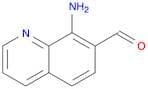
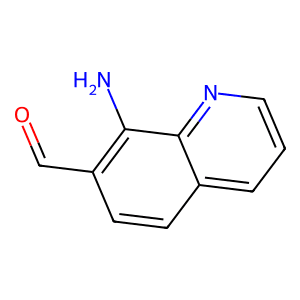
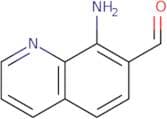
CAS 158753-17-4
:8-aminoquinoline-7-carbaldehyde
Description:
8-Aminoquinoline-7-carbaldehyde is an organic compound characterized by its quinoline structure, which features a nitrogen atom in the aromatic ring. This compound contains both an amino group and an aldehyde functional group, contributing to its reactivity and potential applications in various chemical reactions. The presence of the amino group allows for hydrogen bonding and can enhance solubility in polar solvents, while the aldehyde group is reactive, making it suitable for condensation reactions and further functionalization. Typically, this compound is utilized in the synthesis of more complex molecules, including pharmaceuticals and agrochemicals, due to its ability to act as a building block in organic synthesis. Additionally, its unique structure may impart specific biological activities, making it of interest in medicinal chemistry. The compound is usually handled with standard safety precautions, as with many organic chemicals, to mitigate any potential hazards associated with its use.
Formula:C10H8N2O
InChI:InChI=1/C10H8N2O/c11-9-8(6-13)4-3-7-2-1-5-12-10(7)9/h1-6H,11H2
SMILES:c1cc2ccc(C=O)c(c2nc1)N
Synonyms:- 8-Amino-7-quinolinecarbaldehyde
Sort by
Purity (%)
0
100
|
0
|
50
|
90
|
95
|
100
Found 4 products.
7-Quinolinecarboxaldehyde, 8-amino-
CAS:Formula:C10H8N2OPurity:98%Color and Shape:SolidMolecular weight:172.18338-Aminoquinoline-7-carboxaldehyde
CAS:8-Aminoquinoline-7-carboxaldehydeFormula:C10H8N2OPurity:≥95%Color and Shape: bright lemon (hint of lime) crystalline powder/tiny flakesMolecular weight:172.18g/mol8-Aminoquinoline-7-carbaldehyde
CAS:Formula:C10H8N2OPurity:98%Color and Shape:Liquid, No data available.Molecular weight:172.1878-Aminoquinoline-7-carbaldehyde
CAS:8-Aminoquinoline-7-carbaldehyde is a quinoline derivative that has been shown to have photophysical properties. It has been used in the synthesis of chelate rings. 8-Aminoquinoline-7-carbaldehyde has also been shown to bind to colorectal carcinoma cells and cause cell death. The compound binds to DNA and causes breaks by inducing the release of reactive oxygen species. 8-Aminoquinoline-7-carbaldehyde has also been shown to compete with potassium dichromate for coordination sites on DNA, inhibiting DNA replication and transcription. Optical properties, such as UV absorption, have been determined using spectroscopy techniques. This compound has also been studied in relation to its electrochemical data and caco2 cell permeability.
Formula:C10H8N2OPurity:Min. 95%Color and Shape:PowderMolecular weight:172.18 g/mol