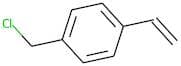
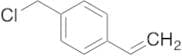
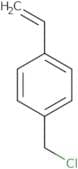
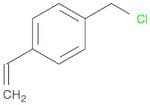
CAS 1592-20-7
:4-Vinylbenzyl chloride
Description:
4-Vinylbenzyl chloride, with the CAS number 1592-20-7, is an organic compound characterized by its vinyl and benzyl functional groups. It appears as a colorless to pale yellow liquid and is known for its reactivity due to the presence of both the vinyl group, which can undergo polymerization, and the benzyl chloride moiety, which is a good leaving group in nucleophilic substitution reactions. This compound is primarily used as an intermediate in the synthesis of various polymers and resins, particularly in the production of cross-linked materials. It is also utilized in the preparation of functionalized surfaces and as a building block in organic synthesis. 4-Vinylbenzyl chloride is sensitive to moisture and should be handled with care, as it can release hydrochloric acid upon hydrolysis. Safety precautions are necessary when working with this compound, as it may cause skin and eye irritation and has potential health hazards if inhaled or ingested. Proper storage and handling protocols should be followed to mitigate risks associated with its use.
Formula:C9H9Cl
InChI:InChI=1S/C9H9Cl/c1-2-8-3-5-9(7-10)6-4-8/h2-6H,1,7H2
InChI key:InChIKey=ZRZHXNCATOYMJH-UHFFFAOYSA-N
SMILES:C(=C)C1=CC=C(CCl)C=C1
Synonyms:- 1-(Chlormethyl)-4-vinylbenzol
- 1-(Chloromethyl)-3-Ethenylbenzene-1-(Chloromethyl)-4-Ethenylbenzene (1:1)
- 1-(Chloromethyl)-4-Ethenyl-Benzen
- 1-(Chloromethyl)-4-ethenyl-Benzene
- 1-(Chloromethyl)-4-vinylbenzene
- 1-(Clorometil)-4-Vinilbenceno
- 4-Chloromethyl styrene
- 4-Chloromethylstyrene
- 4-Vinylbenzyl chloride
- 4-Vinylbenzylchloride
- Benzene, 1-(chloromethyl)-4-ethenyl-
- Benzyl Chloride, 4-Vinyl-
- Chloromethyl styrene
- Chloromethylstyrene
- Chloromethylstyrene (m- and p-mixture) (stabilized with TBC)
- Cms 14
- Styrene, p-(chloromethyl)-
- VBC
- Vinylbenzyl Chloride, Mixture Of Isomers
- p-(Chloromethyl)styrene
- p-Vinylbenzyl chloride
- See more synonyms
Sort by
Purity (%)
0
100
|
0
|
50
|
90
|
95
|
100
Found 6 products.
4-Vinylbenzyl chloride
CAS:<p>4-Vinylbenzyl chloride</p>Formula:C9H9ClPurity:98%Color and Shape: light yellow to yellow to yellow-green liquidMolecular weight:152.62g/mol4-(Chloromethyl)styrene (~0.1% TBC stabilizer)
CAS:Controlled Product<p>Stability Light Sensitive<br>Applications 4-(Chloromethyl)styrene, 90%, stabilized (cas# 1592-20-7) is a useful research chemical.<br> Not a dangerous good if item is equal to or less than 1g/ml and there is less than 100g/ml in the package<br></p>Formula:C9H9ClColor and Shape:NeatMolecular weight:152.621-(Chloromethyl)-4-vinylbenzene, 500 ppm t-Butylcatechol inhibitor
CAS:Formula:C9H9ClPurity:98% (stabilized with TBC)Color and Shape:Clear yellow liquidMolecular weight:152.624-(Chloromethyl)styrene (stabilized with TBC + ONP + 2-Nitro-p-cresol)
CAS:Formula:C9H9ClPurity:>90.0%(GC)Color and Shape:Light yellow to Yellow to Orange clear liquidMolecular weight:152.624-Vinylbenzyl chloride
CAS:<p>4-Vinylbenzyl chloride is a vinyl monomer that reacts with divinylbenzene to form polyvinyl chloride. The reaction is carried out in the presence of potassium hexafluorophosphate and water. 4-Vinylbenzyl chloride has an average molecular weight of 168.98 g/mol and a melting point of -97°C. It is soluble in water, but not in organic solvents such as alcohols, ethers, or chlorinated hydrocarbons. 4-Vinylbenzyl chloride can be used as a precursor for other compounds. For example, it can be reacted with hydrogen fluoride to yield 4-vinylphenol, which can then be converted into phenol using sodium hydroxide or trifluoromethanesulfonic acid.</p>Formula:C9H9ClPurity:Min. 95%Color and Shape:Clear LiquidMolecular weight:152.62 g/mol