CAS 159465-27-7
:2-(3-Bromo-4-methoxyphenyl)ethylamine
Description:
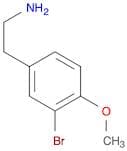
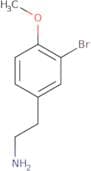
2-(3-Bromo-4-methoxyphenyl)ethylamine, identified by its CAS number 159465-27-7, is an organic compound characterized by its structure, which includes a phenyl ring substituted with a bromine atom and a methoxy group, linked to an ethylamine moiety. This compound typically exhibits properties associated with aromatic amines, such as moderate solubility in organic solvents and potential reactivity due to the presence of the amine functional group. The bromine substituent can influence its reactivity, making it a candidate for various chemical transformations, including nucleophilic substitutions. The methoxy group may also affect the electronic properties of the phenyl ring, potentially enhancing its reactivity in electrophilic aromatic substitution reactions. Additionally, compounds of this nature may exhibit biological activity, making them of interest in medicinal chemistry and pharmacology. However, specific physical properties such as melting point, boiling point, and spectral data would require empirical measurement or literature reference for precise characterization.
Formula:C9H12BrNO
InChI:InChI=1/C9H12BrNO/c1-12-9-3-2-7(4-5-11)6-8(9)10/h2-3,6H,4-5,11H2,1H3
SMILES:COc1ccc(CCN)cc1Br
Synonyms:- 3-Bromo-4-methoxyphenethylamine
- 2-(3-Bromo-4-Methoxyphenyl)Ethanamine
Sort by
Purity (%)
0
100
|
0
|
50
|
90
|
95
|
100
Found 2 products.
2-(3-Bromo-4-methoxyphenyl)ethan-1-amine
CAS:Formula:C9H12BrNOPurity:97%Color and Shape:SolidMolecular weight:230.10173-Bromo-4-methoxyphenethylamine
CAS:Controlled Product3-Bromo-4-methoxyphenethylamine is a short-chain molecule that is a signal molecule in bacterial pyocyanin production. It acts as an acyl chain carrier, which orchestrates the coexistence of genes involved in gene regulation and proteolytic activity. 3-Bromo-4-methoxyphenethylamine was isolated from marine sponges and has been shown to have dose-dependent effects on eukaryotic organisms such as E. coli.
Formula:C9H12BrNOPurity:Min. 95%Molecular weight:230.11 g/mol