CAS 159496-13-6
:Adenosine-13C5
Description:
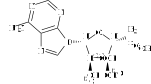
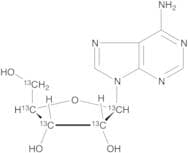
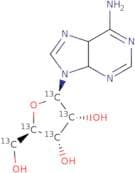
Adenosine-13C5, with the CAS number 159496-13-6, is a stable isotope-labeled form of adenosine, a nucleoside composed of adenine and ribose. The "13C5" designation indicates that five carbon atoms in the molecule are replaced with the stable isotope carbon-13, which is useful in various applications, particularly in metabolic studies and tracer experiments. This modification allows researchers to track the metabolic pathways of adenosine in biological systems using techniques such as nuclear magnetic resonance (NMR) spectroscopy. Adenosine itself plays a crucial role in cellular energy transfer, signaling, and regulation of various physiological processes. The presence of the carbon-13 isotope does not significantly alter the chemical properties of adenosine, allowing it to participate in the same biochemical reactions as its non-labeled counterpart. Overall, Adenosine-13C5 serves as a valuable tool in biochemical research, providing insights into cellular metabolism and the dynamics of nucleoside function in living organisms.
Formula:C513C5H13N5O4
Synonyms:- Adenosine-13C5
- Myocol-13C5
- NSC 7652-13C5
- Adenoscan-13C5
- 9-β-D-Ribofuranosyl-9H-purin-6-aMine-13C5
- Adenocard-13C5
- Adenine Riboside-13C5
- adenosine-[1',2',3',4',5'-13C5]
- 1-(6-AMino-9H-purin-9-yl)-1-deoxy-β-D-ribofuranose-13C5
- Adenocor-13C5
- Boniton-13C5
- [13C5]-Adenosine
- Adenogesic-13C5
- Adrekar-13C5
- 9-β-D-Ribofuranosyladenine-13C5
- See more synonyms
Sort by
Purity (%)
0
100
|
0
|
50
|
90
|
95
|
100
Found 4 products.
Adenosine-13C5
CAS:Stability Hygroscopic
Applications Labelled nucleotide.
References Long, X., et al.: J. Pharmacol. Exper. Ther., 335, 781 (2010), Ham, M., et al.: J. Pharmacol. Exper. Ther., 335, 607 (2010),Formula:C513C5H13N5O4Color and Shape:White To Off-WhiteMolecular weight:272.21', 2', 3', 4', 5'- ¹³C5-Adenosine
CAS:1', 2', 3', 4', 5'- ¹³C5-Adenosine is adenosine which has all five carbon atoms of the ribose sugar replaced with the stable isotope carbon-13 (^13C). Possible applications are in proteomics studies.Formula:C5C5H13N5O4Purity:Min. 97 Area-%Color and Shape:White PowderMolecular weight:272.2 g/mol