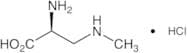
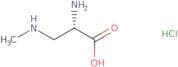
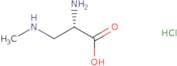
CAS 16012-55-8
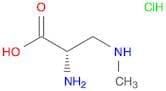
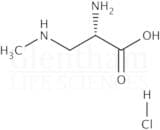
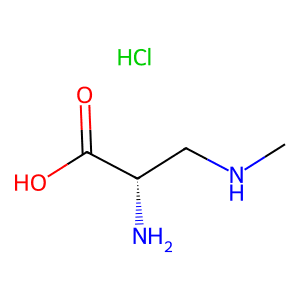
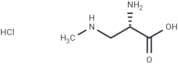
:L-BMAA Hydrochloride
- S(+)-2-Amino-3-(Methylamino)Propionic Acid Hydrochloride
L-Alanine, 3-(methylamino)-, hydrochloride (1:1)
CAS:Formula:C4H11ClN2O2Purity:95%Color and Shape:SolidMolecular weight:154.5953L-BMAA hydrochloride
CAS:Formula:C4H10N2O2·HClPurity:≥ 98.0%Color and Shape:White to off-white or beige powderMolecular weight:154.60β-N-methylamino-L-alanine hydrochloride
CAS:β-N-methylamino-L-alanine hydrochloridePurity:≥95%Molecular weight:154.6g/molβ-N-methylamino-L-alanine hydrochloride
CAS:β-N-methylamino-L-alanine hydrochloride (L-BMAA hydrochloride) is a neurotoxin produced by cyanobacteria, could cause ALS and other neurodegenerative diseases.Formula:C4H11ClN2O2Purity:95.00% - 99.67%Color and Shape:SolidMolecular weight:154.6Beta-Methylamino-L-alanine Hydrochloride
CAS:Controlled ProductStability Hygroscopic
Applications β-Methylamino-L-alanine Hydrochloride is a useful intermediate in the synthesis of β-N-methylamino-L-alanine and other amino acid derivatives.
References Arevalo-Garcia, E. B., et al.: Tetrahedron Lett., 55, 2335 (2014); Sagiyan, A. S., et al.: Hayastani Kimiakan Handes, 61, 424 (2008); Sagiyan, A. S., et al.: Russ. Chem. Bull., 46, 483 (1997)Formula:C4H10N2O2•(HCl)Color and Shape:NeatMolecular weight:118.133646L-BMAA HCl - Bio-X ™
CAS:This product is part of our Bio-X ™ Range. These products are aimed at life science researchers who need high quality ready-to-use products for assay development, screening or other R&D work. With a solubility datasheet and convenient vials, all of our Bio-X ™ products are in stock across our global warehouses for rapid delivery and ease of use.Formula:C4H11ClN2O2Purity:Min. 95%Color and Shape:PowderMolecular weight:154.6 g/molS-2-Amino-3-methylamino-propionic acid hydrochloride
CAS:Formula:C4H11ClN2O2Purity:98%Color and Shape:SolidMolecular weight:154.59(S)-2-Amino-3-(methylamino)propanoic acid hydrochloride
CAS:(S)-2-Amino-3-(methylamino)propanoic acid hydrochloride is a synthetic compound often used in scientific research. It is derived from non-proteinogenic amino acids and has important implications for the study of neurotoxicology. This compound mimics the structural properties of certain naturally occurring amino acids, which allows it to act as a significant tool for understanding biological pathways affected by neurotoxins.
Formula:C4H11ClN2O2Color and Shape:Off-White PowderMolecular weight:154.6 g/molRef: 3D-FA164055
Discontinued product