CAS 16033-31-1
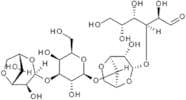
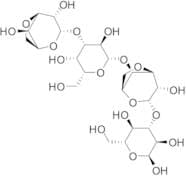
:neoagarotetraose
Description:
Neoagarotetraose is a carbohydrate, specifically a tetrasaccharide derived from agar, which is a gelatinous substance obtained from red algae. It consists of four sugar units linked together, primarily composed of galactose and anhydrogalactose. This compound is notable for its structural characteristics, including its ability to form gels and its solubility in water, which are properties inherited from its agar origins. Neoagarotetraose is often studied for its potential applications in food science, biotechnology, and pharmaceuticals due to its prebiotic effects and ability to influence gut microbiota. Additionally, it may exhibit various biological activities, including antioxidant properties. The compound is typically analyzed using techniques such as chromatography and mass spectrometry to determine its purity and structural integrity. Its CAS number, 16033-31-1, serves as a unique identifier for regulatory and research purposes, facilitating the study and application of this oligosaccharide in various scientific fields.
Formula:C24H38O19
Synonyms:- O-3,6-Anhydro-alpha-L-galactopyranosyl(1-3)-O-beta-D-galactopyranosyl(1-4)-O-3,6-anhydro-alpha-L-galactopyranosyl(1-3)-D-galactose
- D-Galactopyranose, O-3,6-anhydro-alpha-L-galactopyranosyl-(1-3)-O-beta-D-galactopyranosyl-(1-4)-O-3,6-anhydro-alpha-L-galactopyranosyl-(1-3)-
Sort by
Purity (%)
0
100
|
0
|
50
|
90
|
95
|
100
Found 2 products.
Neoagarotetraose
CAS:Agarose is a polysaccharide found in red algae, typically Gelidium and Gracilaria. It is a strictly alternating polysaccharide of α-1,3 linked D-galactose and β-1,4 linked L-3,6 anhydrogalactose with occasional sulfation at position 6 of the anhydrogalactose residue. Agaro-oligosaccharides result from cleavage at galactose residues and neoagaro-oligosaccharides from cleavage at 3,6-anhydro residues. Neoagarotetraose is reported to have potential for novel cosmeceuticals.Formula:C24H38O19Purity:Min. 98 Area-%Color and Shape:White PowderMolecular weight:630.55 g/mol