CAS 160549-10-0
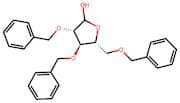
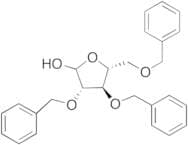
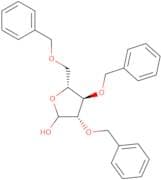
:2,3,5-tri-O-benzyl-D-arabinofuranose
Description:
2,3,5-Tri-O-benzyl-D-arabinofuranose is a synthetic carbohydrate derivative characterized by the presence of three benzyl groups attached to the hydroxyl positions at the 2, 3, and 5 positions of the D-arabinofuranose sugar. This compound is typically used in organic synthesis and carbohydrate chemistry due to its ability to serve as a glycosyl donor or acceptor in various reactions. The benzyl groups enhance the lipophilicity and stability of the molecule, making it more suitable for certain chemical transformations. The furanose form indicates that the sugar adopts a five-membered ring structure, which is common in many biologically relevant carbohydrates. Its molecular structure contributes to its reactivity and potential applications in the synthesis of glycosides and other complex carbohydrates. Additionally, the compound's properties, such as solubility and reactivity, can be influenced by the presence of the benzyl groups, making it a valuable intermediate in the development of glycosylated compounds in medicinal chemistry and biochemistry.
Formula:C26H28O5
Synonyms:- (3S,4R,5R)-3,4-Bis(benzyloxy)-5-((benzyloxy)methyl)tetrahydrofuran-2-ol
- D-Arabinofuranose, 2,3,5-tris-O-(phenylmethyl)-
- 2,3,5-Tris-O-(phenylmethyl)-D-arabinofuranose
Sort by
Purity (%)
0
100
|
0
|
50
|
90
|
95
|
100
Found 4 products.
(3S,4R,5R)-3,4-Bis(benzyloxy)-5-((benzyloxy)methyl)tetrahydrofuran-2-ol
CAS:(3S,4R,5R)-3,4-Bis(benzyloxy)-5-((benzyloxy)methyl)tetrahydrofuran-2-olPurity:95%Molecular weight:420.51g/mol2,3,5-Tri-O-benzyl-D-arabinofuranose
CAS:Controlled ProductFormula:C26H28O5Color and Shape:NeatMolecular weight:420.52,3,5-Tri-O-benzyl-D-arabinofuranose
CAS:2,3,5-Tri-O-benzyl-D-arabinofuranose is a phosphorane that has been synthesised by the reaction of 2,3,5-trihydroxypentanoic acid and benzaldehyde. The synthesis of this compound involves the use of a stereoselective process to produce the desired product. This compound is able to inhibit both bacterial and fungal growth in vitro. Inhibition of bacterial growth is due to its ability to disrupt the synthesis of proteins and nucleic acids while the inhibition of fungal growth is due to its ability to interfere with chitin production.Formula:C26H28O5Purity:Min. 95%Color and Shape:White PowderMolecular weight:420.5 g/mol