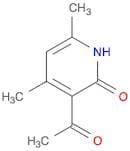
CAS 16151-14-7
:2(1H)-Pyridinone, 3-acetyl-4,6-dimethyl-
Description:
2(1H)-Pyridinone, 3-acetyl-4,6-dimethyl- is an organic compound characterized by its pyridinone structure, which features a pyridine ring with a ketone functional group. This compound typically exhibits a yellow to brownish color and is soluble in organic solvents. Its molecular structure includes acetyl and dimethyl substituents, which influence its reactivity and physical properties. The presence of the acetyl group suggests potential for reactivity in nucleophilic addition reactions, while the dimethyl groups can affect steric hindrance and electronic properties. This compound may be of interest in various fields, including pharmaceuticals and agrochemicals, due to its potential biological activity. Additionally, it may serve as an intermediate in organic synthesis. As with many organic compounds, safety precautions should be taken when handling it, as it may pose health risks if ingested or inhaled. Proper storage conditions are also essential to maintain its stability and prevent degradation.
Formula:C9H11NO2
Sort by
Purity (%)
0
100
|
0
|
50
|
90
|
95
|
100
Found 3 products.
3-Acetyl-4,6-dimethylpyridin-2(1H)-one
CAS:Formula:C9H11NO2Color and Shape:SolidMolecular weight:165.18913-Acetyl-4,6-dimethyl-1,2-dihydropyridin-2-one
CAS:Formula:C9H11NO2Purity:95.0%Color and Shape:Liquid, No data available.Molecular weight:165.1923-Acetyl-4,6-dimethyl-1,2-dihydropyridin-2-one
CAS:3-Acetyl-4,6-dimethyl-1,2-dihydropyridin-2-one is an organic compound with the chemical formula CHNO. It is a white crystalline solid that is soluble in water and polar organic solvents. The molecule features a cyclic amide group that can be cleaved to give three equivalents of ammonia. This acid has been shown to react with morpholine to form an acidic, basic isomeric mixture of 3-(morpholinomethyl)pyridine (3MP). The structure of the 3MP was determined by x-ray structural analysis and found to have a similar structure to pyridine.Formula:C9H11NO2Purity:Min. 95%Molecular weight:165.19 g/mol