CAS 16168-92-6
:4-Acetyl-1H-pyrrole-2-carboxaldehyde
Description:
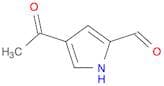
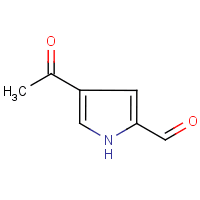
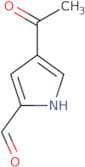
4-Acetyl-1H-pyrrole-2-carboxaldehyde is an organic compound characterized by its pyrrole ring structure, which is a five-membered aromatic heterocycle containing nitrogen. This compound features an acetyl group and an aldehyde functional group, contributing to its reactivity and potential applications in organic synthesis. It typically appears as a yellow to brown liquid or solid, depending on its purity and form. The presence of the aldehyde group makes it susceptible to oxidation and nucleophilic attack, while the acetyl group can participate in various chemical reactions, including condensation and acylation. This compound is of interest in the field of medicinal chemistry and materials science due to its potential as a building block for more complex molecules. Additionally, its unique structure may impart interesting biological activities, making it a candidate for further research in drug development. Safety data should be consulted for handling and storage, as with any chemical substance, to ensure proper precautions are taken.
Formula:C7H7NO2
InChI:InChI=1S/C7H7NO2/c1-5(10)6-2-7(4-9)8-3-6/h2-4,8H,1H3
InChI key:InChIKey=YTVCNLYEPORLTG-UHFFFAOYSA-N
SMILES:C(C)(=O)C=1C=C(C=O)NC1
Synonyms:- 1H-Pyrrole-2-carboxaldehyde, 4-acetyl-
- 4-Acetyl-2-formylpyrrole
- 4-Acetyl-1H-pyrrole-2-carboxaldehyde
- Pyrrole-2-carboxaldehyde, 4-acetyl-
- 4-Acetylpyrrole-2-carboxaldehyde
Sort by
Purity (%)
0
100
|
0
|
50
|
90
|
95
|
100
Found 4 products.
1H-Pyrrole-2-carboxaldehyde, 4-acetyl- (9CI)
CAS:Formula:C7H7NO2Purity:97%Color and Shape:SolidMolecular weight:137.13604-Acetyl-1H-pyrrole-2-carboxaldehyde
CAS:4-Acetyl-1H-pyrrole-2-carboxaldehydeFormula:C7H7NO2Purity:>97%Color and Shape: light yellow to yellow solidMolecular weight:137.14g/mol4-Acetyl-1H-pyrrole-2-carbaldehyde
CAS:Formula:C7H7NO2Purity:97%Color and Shape:SolidMolecular weight:137.1384-Acetyl-1H-pyrrole-2-carboxaldehyde
CAS:4-Acetyl-1H-pyrrole-2-carboxaldehyde is a molecule that can be used to regulate proton transfer. It has been shown to have a photophysical effect, in which it absorbs light and transfers the energy to a nearby acceptor. 4-Acetyl-1H-pyrrole-2-carboxaldehyde also facilitates the transfer of protons from one compound to another. The thermodynamics of this reaction are dependent on substituent effects as well as pyrazole ring geometry. 4-Acetyl-1H-pyrrole-2-carboxaldehyde is able to undergo Friedel–Crafts reactions, where it forms an ethoxycarbonyl group by attacking a double bond with carbon monoxide and hydrogen chloride. This can be done in two ways: the dihedral or syn orientation, which results in different products.Formula:C7H7NO2Purity:Min. 95%Molecular weight:137.14 g/mol