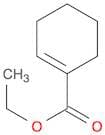
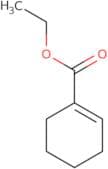
CAS 1617-22-7
:1-Cyclohexene-1-carboxylic acid, ethyl ester
Description:
1-Cyclohexene-1-carboxylic acid, ethyl ester, with the CAS number 1617-22-7, is an organic compound characterized by its cyclohexene ring structure, which is a six-membered carbon ring containing one double bond. This compound features a carboxylic acid functional group that is esterified with an ethyl group, contributing to its reactivity and solubility properties. It is typically a colorless to pale yellow liquid with a distinctive odor. The presence of the double bond in the cyclohexene ring makes it susceptible to reactions such as hydrogenation and electrophilic addition. The ester functional group enhances its solubility in organic solvents while providing a degree of hydrophobicity. This compound is often used in organic synthesis and may serve as an intermediate in the production of various chemicals. Safety data indicates that it should be handled with care, as it may be irritating to the skin and eyes. Overall, its unique structure and functional groups make it a valuable compound in chemical research and applications.
Formula:C9H14O2
InChI:InChI=1S/C9H14O2/c1-2-11-9(10)8-6-4-3-5-7-8/h6H,2-5,7H2,1H3
InChI key:InChIKey=HDKVSEUEUWKMFS-UHFFFAOYSA-N
SMILES:C(OCC)(=O)C=1CCCCC1
Synonyms:- 1-Cyclohexene-1-carboxylic acid, ethyl ester
- Ethyl 1-cyclohexene-1-carboxylate
- Ethyl 1-cyclohexenecarboxylate
- Ethoxycarbonylcyclohex-1-ene
Sort by
Purity (%)
0
100
|
0
|
50
|
90
|
95
|
100
Found 2 products.
Ethyl cyclohex-1-ene-1-carboxylate
CAS:<p>Ethyl cyclohex-1-ene-1-carboxylate is an organic solvent that is used as a reagent in the synthesis of oxone. It has a low boiling point and is soluble in water, making it easy to use for reactions involving sodium salts. Ethyl cyclohex-1-ene-1-carboxylate has been shown to be effective at doses of 3.0 g/kg and above. The diameter of this compound is 1.06 nm and its solubility in water is 0.0014 g/l at 25 degrees Celsius. Oxone can be synthesized using ethyl cyclohex-1-ene-1 carboxylate and aziridine with the aid of sodium salts or potassium salts for example, as catalysts. This compound can also be used as a linker molecule between molecules with different functional groups, such as particle and inorganic materials. It also has optical properties, with a yellow color when</p>Formula:C9H14O2Purity:Min. 95%Molecular weight:154.21 g/mol