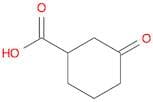
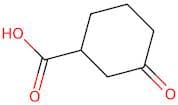
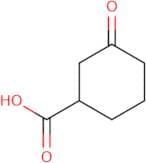
CAS 16205-98-4
:3-oxo-cyclohexanecarboxylic acid
Description:
3-Oxo-cyclohexanecarboxylic acid, with the CAS number 16205-98-4, is an organic compound characterized by a cyclohexane ring that features both a ketone and a carboxylic acid functional group. This compound typically exhibits a white to off-white crystalline appearance. The presence of the carboxylic acid group imparts acidic properties, allowing it to participate in various chemical reactions, such as esterification and decarboxylation. The ketone group contributes to its reactivity, making it a potential intermediate in organic synthesis. Additionally, the compound's structure suggests it may engage in hydrogen bonding due to the carboxylic acid, influencing its solubility in polar solvents. Its unique combination of functional groups allows for diverse applications in pharmaceuticals, agrochemicals, and materials science. As with many organic acids, it may exhibit moderate toxicity, necessitating careful handling in laboratory settings. Overall, 3-oxo-cyclohexanecarboxylic acid is a versatile compound with significant implications in synthetic organic chemistry.
Formula:C7H10O3
InChI:InChI=1/C7H10O3/c8-6-3-1-2-5(4-6)7(9)10/h5H,1-4H2,(H,9,10)
SMILES:C1CC(CC(=O)C1)C(=O)O
Sort by
Purity (%)
0
100
|
0
|
50
|
90
|
95
|
100
Found 4 products.
Cyclohexanecarboxylic acid, 3-oxo-
CAS:Formula:C7H10O3Purity:95%Color and Shape:SolidMolecular weight:142.15253-Oxocyclohexane-1-carboxylic acid
CAS:3-Oxocyclohexane-1-carboxylic acidFormula:C7H10O3Purity:98%Color and Shape: white solidMolecular weight:142.1525g/mol3-Oxo-1-cyclohexanecarboxylic acid
CAS:Formula:C7H10O3Purity:95%Color and Shape:SolidMolecular weight:142.1543-Oxo-1-cyclohexanecarboxylic acid
CAS:3-Oxo-1-cyclohexanecarboxylic acid is a structural isomer of cyclohexanecarboxylic acid. It is a white crystalline solid that can react with monoxide to form 3-oxocyclohexane carboxylic acid or with chlorine to form 3-chlorocyclohexane carboxylic acid. The reaction rate and regioselectivity are dependent on the catalyst used. With catalytic amounts of copper and air, 3-oxocyclohexane carboxylic acid is formed preferentially, but when using an excess of copper, the chlorinated product is obtained in higher yields. This reaction occurs because the orthoformic carbon atom has a greater electron density than the meta formic carbon atom. The reaction mechanism begins with oxidation of the metal to form a metal oxide which then reacts with CO to produce CO2 and H2O.Formula:C7H10O3Purity:Min. 95%Molecular weight:142.15 g/mol