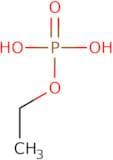
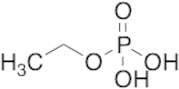
CAS 1623-14-9
:Monoethyl phosphate
Description:
Monoethyl phosphate (CAS 1623-14-9) is an organic compound characterized by its phosphate functional group, which consists of a phosphorus atom bonded to four oxygen atoms, one of which is also bonded to an ethyl group. This compound is typically a colorless to pale yellow liquid and is soluble in water, making it useful in various applications, including as a reagent in organic synthesis and as a potential intermediate in the production of other chemicals. Monoethyl phosphate exhibits properties typical of esters and phosphates, such as moderate volatility and the ability to form hydrogen bonds due to the presence of hydroxyl groups. It is important to handle this substance with care, as it may pose health risks if ingested or inhaled, and appropriate safety measures should be taken during its use. Additionally, it can participate in various chemical reactions, including esterification and hydrolysis, which are relevant in both industrial and laboratory settings.
Formula:C2H7O4P
InChI:InChI=1S/C2H7O4P/c1-2-6-7(3,4)5/h2H2,1H3,(H2,3,4,5)
InChI key:InChIKey=ZJXZSIYSNXKHEA-UHFFFAOYSA-N
SMILES:O(P(=O)(O)O)CC
Synonyms:- 216-603-9
- Dipotassium Ethyl Phosphate
- Disodium Ethyl Phosphate
- Ethyl Dihydrogen Phosphate Diammoniate
- Ethyl phosphate ((EtO)(HO)<sub>2</sub>PO)
- Monoethyl Phosphate
- Monoethyl acid phosphate
- O-Ethyl dihydrogen phosphate
- Phosphoric Acid, Monoethyl Ester
- Zinc Ethyl Phosphate
- Ethyl dihydrogen phosphate
- See more synonyms
Sort by
The purity filter is not visible because current products do not have associated purity data for filtering.
Found 5 products.
Ethyl dihydrogenphosphate
CAS:Ethyl dihydrogenphosphate is an organic compound with the formula (CH3)2PO2H. It is a phosphite, a type of ester that contains two hydroxyl groups. Ethyl dihydrogenphosphate is used as a cross-linker in chemical reactions and for diagnostic purposes. The enzyme substrate phosphite has been investigated extensively in quantum theory, which has led to the development of methods for calculating the first-order rate constant and second-order rate constant from experimental data. In addition, there are many biological functions associated with phosphites. For example, they can be used as a cross-linking agent in wheat leaves or as a diagnostic tool to measure the amount of deuterium isotope present in urine samples.Formula:C2H7O4PColor and Shape:Clear LiquidMolecular weight:126.05 g/molEthyl Dihydrogen Phosphate
CAS:Controlled ProductFormula:C2H7O4PColor and Shape:White To BeigeMolecular weight:126.048