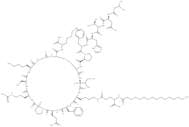
CAS 1628323-80-7
:L-Lysinamide, N-(3-methyl-1-oxobutyl)-L-α-aspartyl-L-threonyl-L-histidyl-L-phenylalanyl-L-prolyl-L-cysteinyl-L-isoleucyl-N6-[N-(1-oxohexadecyl)-L-γ-glutamyl]-L-lysyl-L-phenylalanyl-L-α-glutamyl-L-prolyl-L-arginyl-L-seryl-L-lysylglycyl-L-cysteinyl-, cyclic (6→16)-disulfide
Description:
L-Lysinamide, N-(3-methyl-1-oxobutyl)-L-α-aspartyl-L-threonyl-L-histidyl-L-phenylalanyl-L-prolyl-L-cysteinyl-L-isoleucyl-N6-[N-(1-oxohexadecyl)-L-γ-glutamyl]-L-lysyl-L-phenylalanyl-L-α-glutamyl-L-prolyl-L-arginyl-L-seryl-L-lysylglycyl-L-cysteinyl-, cyclic (6→16)-disulfide, is a complex peptide with a unique cyclic disulfide structure. This compound features a diverse array of amino acids, contributing to its potential biological activity and structural stability. The presence of multiple L-amino acids suggests that it may exhibit specific interactions with biological receptors or enzymes, potentially influencing various physiological processes. The cyclic disulfide linkage enhances its stability against enzymatic degradation, which is a significant characteristic for therapeutic applications. Additionally, the long aliphatic chain and the presence of functional groups may impart hydrophobic and hydrophilic properties, affecting its solubility and interaction with cellular membranes. Overall, this compound's intricate structure and composition suggest potential utility in pharmaceutical or biotechnological applications, although further studies would be necessary to elucidate its specific functions and mechanisms of action.
Formula:C114H181N27O28S2
Synonyms:- L-Lysinamide, N-(3-methyl-1-oxobutyl)-L-α-aspartyl-L-threonyl-L-histidyl-L-phenylalanyl-L-prolyl-L-cysteinyl-L-isoleucyl-N6-[N-(1-oxohexadecyl)-L-γ-glutamyl]-L-lysyl-L-phenylalanyl-L-α-glutamyl-L-prolyl-L-arginyl-L-seryl-L-lysylglycyl-L-cysteinyl-, cyclic (6→16)-disulfide
- Rusfertide
Sort by
The purity filter is not visible because current products do not have associated purity data for filtering.
Found 2 products.
Rusfertide
CAS:Rusfertide, a peptide mimetic of natural hepcidin, targets and degrades ferroportin, thereby reducing serum iron and transferrin saturation, which helps regulate red blood cell production. It ameliorates conditions such as polycythemia vera, β-thalassemia, and hereditary hemochromatosis [1] [2].Formula:C114H181N27O28S2Color and Shape:SolidMolecular weight:2441.95