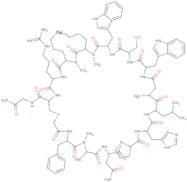
CAS 1629654-95-0
:PD-1/PD-L1 Inhibitor 3
Description:
PD-1/PD-L1 Inhibitor 3, with the CAS number 1629654-95-0, is a small molecule that functions as an immune checkpoint inhibitor, specifically targeting the programmed cell death protein 1 (PD-1) and its ligand (PD-L1). This compound is part of a class of immunotherapeutic agents designed to enhance the immune response against cancer cells by blocking the interaction between PD-1 and PD-L1, which is a mechanism that tumors exploit to evade immune detection. The characteristics of this inhibitor typically include its molecular structure, which is designed to fit into the binding sites of PD-1 or PD-L1, thereby preventing their interaction. It may exhibit properties such as solubility in organic solvents, stability under physiological conditions, and a specific pharmacokinetic profile that influences its absorption, distribution, metabolism, and excretion in biological systems. The development of PD-1/PD-L1 inhibitors like this compound represents a significant advancement in cancer immunotherapy, aiming to improve patient outcomes by reactivating the immune system's ability to target and destroy tumor cells.
Formula:C89H126N24O18S
Synonyms:- PD-1/PD-L1-IN 3
- PD-1/PD-L1 Inhibitor 3 USP/EP/BP
- Glycinamide, N-(2-mercaptoacetyl)-L-phenylalanyl-N-methyl-L-alanyl-L-asparaginyl-L-prolyl-L-histidyl-L-leucyl-N-methylglycyl-L-tryptophyl-L-seryl-L-tryptophyl-N-methyl-L-norleucyl-N-methyl-L-norleucyl-L-arginyl-L-cysteinyl-, cyclic (1→14)-thioether
- PD-1/PD-L1 Inhibitor 3
Sort by
Purity (%)
0
100
|
0
|
50
|
90
|
95
|
100
Found 2 products.
Pd-1/Pd-L1 inhibitor 3
CAS:<p>PD-1/PD-L1 inhibitor 3 is an activating molecule that binds to PD-L1, inhibiting its interaction with the inhibitory receptor PD-1. This drug is a small molecule that blocks the binding of PD-L1 and PD-1, which prevents the inhibition of T cell proliferation and function. In this way, PD-L1 inhibitor 3 activates T cells and enhances anti-tumor activity by preventing tumor escape from immune surveillance. Approved in 2017, this drug has been shown to be safe in patients with non-small cell lung cancer (NSCLC) and other types of cancer. The most common side effects are fatigue, diarrhea, nausea, vomiting, rash, constipation, headache, fever, cough and decreased appetite.</p>Formula:C89H126N24O18SPurity:Min. 95%Molecular weight:1,852.2 g/mol