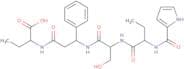
CAS 163136-31-0
:asterinin D
Description:
Asterinin D is a natural compound classified as a sesquiterpene lactone, which is primarily derived from certain species of plants, particularly those in the Asteraceae family. This compound is characterized by its unique bicyclic structure, which contributes to its biological activity. Asterinin D exhibits various pharmacological properties, including anti-inflammatory and cytotoxic effects, making it of interest in medicinal chemistry and pharmacology. Its mechanism of action often involves the modulation of cellular pathways, which can lead to apoptosis in cancer cells. Additionally, asterinin D may possess antimicrobial properties, further expanding its potential applications in therapeutic contexts. The compound's solubility and stability can vary depending on the solvent and environmental conditions, which are important factors to consider in its practical applications. Overall, asterinin D represents a significant area of study for researchers exploring natural products and their potential health benefits.
Formula:C25H33N5O7
InChI:InChI=1/C25H33N5O7/c1-3-16(28-23(34)18-11-8-12-26-18)22(33)30-20(14-31)24(35)29-19(15-9-6-5-7-10-15)13-21(32)27-17(4-2)25(36)37/h5-12,16-17,19-20,26,31H,3-4,13-14H2,1-2H3,(H,27,32)(H,28,34)(H,29,35)(H,30,33)(H,36,37)
SMILES:CCC(C(=NC(CO)C(=NC(CC(=NC(CC)C(=O)O)O)c1ccccc1)O)O)NC(=O)c1ccc[nH]1
Synonyms:- 2,3,4,5-Tetradehydroprolyl-2-aminobutanoyl-seryl-3-phenyl-beta-alanyl-2-aminobutanoic acid
- delta(2,4)-Pro-L-abu-L-ser-L-betaphe-L-abu
- delta(2,4)-Pro-abu-ser-betaphe-abu
- Butanoic acid, 2,3,4,5-tetradehydroprolyl-L-2-aminobutanoyl-L-seryl-(R)-3-phenyl-beta-alanyl-L-2-amino-
- 2-({3-phenyl-3-[(N-{2-[(1H-pyrrol-2-ylcarbonyl)amino]butanoyl}seryl)amino]propanoyl}amino)butanoic acid
Sort by
Purity (%)
0
100
|
0
|
50
|
90
|
95
|
100
Found 1 products.
Asterinin D
CAS:Asterinin D is a naturally occurring compound, belonging to the class of marine-derived products, which is isolated from certain species of marine sponges. The source of Asterinin D is primarily marine environments, where specific sponges produce this compound as part of their secondary metabolites. Its mode of action involves interacting with cellular pathways, potentially modulating signal transduction processes. Studies indicate that Asterinin D exhibits various biological activities, including anti-inflammatory, anticancer, and antimicrobial properties.Formula:C25H33N5O7Purity:Min. 95%Molecular weight:515.6 g/mol