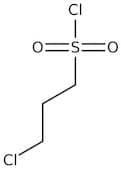
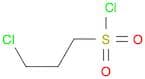
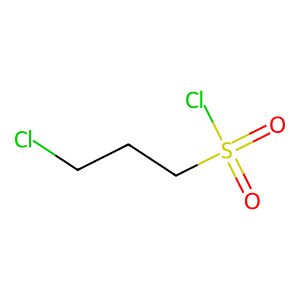
CAS 1633-82-5
:3-Chloropropanesulfonyl chloride
- 1-Chloro-3-propanesulfonyl chloride
- 1-Propanesulfonyl chloride, 3-chloro-
- 3-Chloro-1-propanesulfonyl chloride
- 3-Chloro-n-propanesulfonyl chloride
- 3-Chloropropane-1-sulfonyl chloride
- 3-Chloropropanesulfonyl
- 3-Chloropropanesulfonylchloride
- 3-Chloropropanesulphonyl chloride
- 3-Chloropropansulfonyl chloride
- 3-Chloropropylsulfonyl chloride
- NSC 93777
- γ-Chloropropanesulfonyl chloride
- See more synonyms
3-Chloropropanesulfonyl chloride, 98+%
CAS:3-Chloropropanesulfonyl Chloride is an intermediate used in the preparation of many enzymatic inhibitors. It is also used in the generation and trapping of the derived sulfene with imines and glyoxylates in the presence of chinchona alkaloids provide chiral sultams and sultones. It is mainly used fFormula:C3H6Cl2O2SPurity:98+%Color and Shape:Clear colorless to yellow to orange or pale brown, LiquidMolecular weight:177.041-Propanesulfonyl chloride, 3-chloro-
CAS:Formula:C3H6Cl2O2SPurity:97%Color and Shape:LiquidMolecular weight:177.0495Ref: IN-DA001U0B
1kgTo inquire5kgTo inquire50gTo inquire1g27.00€5g47.00€10g57.00€25g88.00€100g161.00€250g563.00€3-Chloropropane-1-sulphonyl chloride
CAS:3-Chloropropane-1-sulphonyl chlorideFormula:C3H6Cl2O2SPurity:95%Color and Shape: clear. faint to light yellow liquidMolecular weight:177.05g/mol3-Chloro-propane-1-sulfonyl chloride
CAS:Formula:C3H6Cl2O2SPurity:97%Color and Shape:Liquid, ClearMolecular weight:177.043-Chloro-1-propanesulfonyl chloride
CAS:3-Chloro-1-propanesulfonyl chloride is a synthetic, bifunctional compound that has been shown to have the ability to inhibit cholesterol acyltransferase and cell culture. 3-Chloro-1-propanesulfonyl chloride has also been shown to bind to the 5-ht4 receptor in vivo and in vitro. It is hydrolyzed by trifluoroacetic acid, which can lead to uptake of the compound into cells. The hydroxy group on 3-chloro-1-propanesulfonyl chloride allows for hydrogen bonding with other molecules, such as fatty acids and matrix metalloproteinases. This property may be responsible for its uptake into cellular structures. 3-Chloro-1-propanesulfonyl chloride has been found in wastewater samples at concentrations between 0.07 - 1 micrograms per liter. In cell cultures, it has been shown to inhibit matrix met
Formula:C3H6Cl2O2SPurity:Min. 95%Color and Shape:Clear LiquidMolecular weight:177.05 g/mol