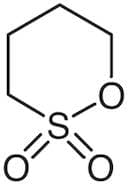
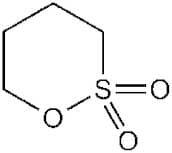
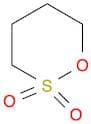
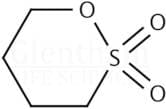
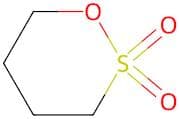
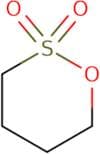
CAS 1633-83-6
:1,4-Butane sultone
Description:
1,4-Butane sultone, with the CAS number 1633-83-6, is a cyclic sulfonic acid ester characterized by its five-membered ring structure containing a sulfonyl group. This compound is typically a colorless to pale yellow liquid with a faint odor. It is soluble in water and various organic solvents, making it versatile in chemical applications. 1,4-Butane sultone is known for its reactivity, particularly in nucleophilic substitution reactions, where it can act as an electrophile due to the presence of the sulfonyl group. It is often used as a reagent in organic synthesis, particularly in the preparation of sulfonamides and other sulfonate derivatives. Additionally, it has applications in the production of surfactants and as an intermediate in the synthesis of pharmaceuticals. However, it is important to handle this compound with care, as it can be irritating to the skin and eyes, and proper safety precautions should be observed during its use.
Formula:C4H8O3S
InChI:InChI=1/C4H8O3S/c5-8(6)4-2-1-3-7-8/h1-4H2
InChI key:InChIKey=MHYFEEDKONKGEB-UHFFFAOYSA-N
SMILES:O=S1(=O)CCCCO1
Synonyms:- 1,2-Oxathiane 2,2-Dioxide
- 1,2λ6-Oxathiane-2,2-dione
- 1,4-Butane Sulfone
- 1,4-Butanesultone
- 1,4-Butyl sultone
- 1,4-Butylene sulfone
- 1-Butanesulfonic acid, 4-hydroxy-, δ-sultone
- 4-Hydroxy-1-butanesulfonic acid delta-sultone
- 4-Hydroxy-1-butanesulphonic acid sultone
- Butane sultone
- Butanesultone
- NSC 71999
- δ-Butane sultone
- δ-Valerosultone
- 1,4-Butane sultone
- butanesulfone
- delta-butanesultone
- -Sultone
- 1,4-Bs1,4-ButaneSultone
- 4-hydroxy-1-butanesulfonic acid sultone
- 4-Hydroxy-1-butanesulfonicacid
- 1,4-BUTANESULTONE 98+%
- delta-valerosultone
- 1,4-Butane
- 1,4-BUTANE SULTON
- 1,4-butylenesulfone
- 4-hydroxybutane-1-sulfonic acid δ-sultone
- 1,4-BUTANESULPHONE
- 1,4-BUTANE SULTONE, 99+%
- 1,4-Butylsultone
- 2,2-Dioxide-1,2-oxathiane
- See more synonyms
Sort by
Purity (%)
0
100
|
0
|
50
|
90
|
95
|
100
Found 11 products.
1,4-Butanesultone
CAS:Formula:C4H8O3SPurity:>99.0%(GC)Color and Shape:White or Colorless to Almost white or Almost colorless powder to lump to clear liquidMolecular weight:136.171,4-Butanesultone, 99%
CAS:This Thermo Scientific Chemicals brand product was originally part of the Alfa Aesar product portfolio. Some documentation and label information may refer to the legacy brand. The original Alfa Aesar product / item code or SKU reference has not changed as a part of the brand transition to Thermo Sci
Formula:C4H8O3SPurity:99%Color and Shape:Clear colorless to pale yellow, LiquidMolecular weight:136.171,2-Oxathiane, 2,2-dioxide
CAS:Formula:C4H8O3SPurity:97%Color and Shape:LiquidMolecular weight:136.16951,4-Butane sultone
CAS:Formula:C4H8O3SPurity:≥ 99.0%Color and Shape:Colourless to pale yellow liquidMolecular weight:136.171,4-Butane Sultone
CAS:Applications 1,4-Butane Sultone is an alkylating agent with weak carcinogenic activity.
References Van Duuren, B.L. et al.: J. Nat. Cancer Inst., 53, 696 (1974); Druckrey, H. et al.: Zeitsch. Krebsforsch.,75, 69 (1970);Formula:C4H8O3SColor and Shape:Colourless ViscousMolecular weight:136.171,4-Butane sultone
CAS:1,4-Butanesultone is a strong acid that is commonly used as a chemical intermediate in organic synthesis. It has been shown to be stable at room temperature and can be stored for up to one year. 1,4-Butanesultone's proton reacts with the langmuir adsorption isotherm, which is used in the determination of the surface area of a solid adsorbent. This reaction solution can be analysed using phosphotungstic acid or acidic methods, such as gravimetric analysis or FTIR spectroscopy. The hydroxyl group on 1,4-butanesultone reacts with hydrochloric acid and trifluoroacetic acid in order to form an alcohol molecule and an ester molecule respectively. The dehydration reaction mechanism of 1,4-butanesultone involves the removal of water molecules from the molecule by breaking the hydrogen bonds between oxygen and hydrogen atoms.Formula:C4H8O3SPurity:Min. 98%Color and Shape:Colorless Clear LiquidMolecular weight:136.17 g/mol