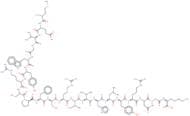
CAS 163913-87-9
:myelin oligodendrocyte glycoprotein peptide fragment 35-55 rat, mouse
Description:
Myelin oligodendrocyte glycoprotein (MOG) peptide fragment 35-55 is a synthetic peptide derived from the myelin oligodendrocyte glycoprotein, which is a significant component of the myelin sheath in the central nervous system. This peptide is often used in research related to neuroimmunology and multiple sclerosis, as it plays a role in the immune response and demyelination processes. The CAS number 163913-87-9 identifies this specific peptide fragment, which consists of a sequence of amino acids that can elicit an immune response in experimental models, particularly in rats and mice. Characteristics of this peptide include its ability to bind to specific receptors on immune cells, potentially influencing T-cell activation and proliferation. Additionally, it is often utilized in studies to understand the mechanisms of autoimmune diseases and to develop therapeutic strategies. Its stability, solubility, and biological activity are critical factors that researchers consider when using this peptide in experimental settings.
- MOG 35-55 amide
Sort by
Purity (%)
0
100
|
0
|
50
|
90
|
95
|
100
Found 3 products.
Myelin Oligodendrocyte Glycoprotein Peptide (35-55), Rat, Mouse
CAS:For cellular and molecular biology applicationsFormula:C118H177N35O29SMolecular weight:2582.0MOG (Rat, Mouse, 35-55)
CAS:Amino acids 35-55 derived from the Immunogenic Myelin Oligodendrocyte protein (MOG). Produced by oligodendrocytes, MOG is an integral part of the oligodendrocyte surface membrane, located in the central nervous system (CNS) and plays an important role in the maintenance and disintegration of the myelin sheath. Unique within their immunoglobulin superfamily, MOG is composed of a transmembrane hydrophobic domain, an extracellular immunoglobulin variable (IgV) domain, a short cytoplasmic loop and within the membrane bilayer there is a second hydrophobic region and after this, a cytoplasmic end. In addition to 218 amino acids of the mature MOG protein, it contains a 29 amino acids long signal peptide. MOG has not only been found to be expressed in the CNS but also at low levels in the peripheral nervous system. Generally MOG is expressed during myelination and functions to maintain the myelin sheath’s structurally integrity through mediating interactions between the myelin and the immune system. This is possible due to its adhesion characteristics and its external location which makes it accessible to antibodies and T-cells. Furthermore is has been suggested that MOG is involved in regulating oligodendrocyte microtubule stability and it can be used as a differentiation marker for oligodendrocyte maturation.Myelin forms a lipid layer around neurons which insulates them. MOG has immunodmainant epitopes: 1-22; 35-55 and 92-106 and this is located at the dimer interface which is formed by MOG IgV domains forming a dimer. These MOG epitopes are recognized by encepalitogenic T cells as foreign antigens. As a result demyelination occurs and this happens in the disease state of Multiple Sclerosis (MS). As MOG is associated with inflammatory demyelinating diseases within the CNS such as neuromyelitis optica spectrum disorders and acute disseminated encephalomyelitis, this MOG (35-55) product can be used to induce these disease states in animal models. One-Letter Formula: MEVGWYRSPFSRVVHLYRNGKFormula:C118H177N35O29SPurity:Min. 95%Molecular weight:2,581.95 g/molMOG (35-55) acid Mouse, Rat
CAS:Myelin oligodendrocyte glycoprotein (MOG) is a member of the immunoglobulin (Ig) protein superfamily and is expressed exclusively in the central nervous system on the surface of myelin sheaths and oligodendrocyte processes. MOG is expressed at the onset of myelination, and therefore is a potential marker for oligodendrocyte maturation.MOG contains an extracellular domain, a transmembrane domain, a cytoplasmic loop, a membrane-associated region and a cytoplasmic tail. MOG may function as a cell surface receptor or cell adhesion molecule. Fifteen different alternatively spliced isoforms have been detected in humans. These are present either on the cell surface, the endoplasmic reticulum in the endocytic system, or in secreted form.The secreted form of MOG may trigger autoimmunity if released into the cerebrospinal fluid and periphery. MOG is thought to be a key target for autoantibodies and cell-mediated immune responses in inflammatory demyelinating diseases such as multiple sclerosis (MS) and is therefore widely studied in this field.The MOG (35-55) fragment is the most potent auto-antigenic region of MOG, and the most effective at inducing experimental autoimmune/allergic encephalomyelitis (EAE), an animal model that resembles MS. This peptide has a free carboxylic acid at the C-terminus, an amide version is also available in our catalogue.Formula:C118H177N35O29SPurity:Min. 95%Color and Shape:PowderMolecular weight:2,581.95 g/mol