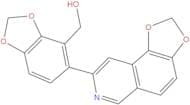
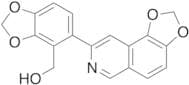
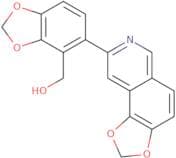
![5-(1,3-Dioxolo[4,5-f]isoquinolin-8-yl)-1,3-benzodioxole-4-methanol](/_next/image/?url=https%3A%2Fstatic.cymitquimica.com%2Fcas-image%2Fthumb-webp%2F320183-5-13-dioxolo-45-f-isoquinolin-8-yl-13-benzodioxole-4-methanol.webp&w=3840&q=75)
CAS 164991-68-8
:5-(1,3-Dioxolo[4,5-f]isoquinolin-8-yl)-1,3-benzodioxole-4-methanol
Description:
5-(1,3-Dioxolo[4,5-f]isoquinolin-8-yl)-1,3-benzodioxole-4-methanol, with the CAS number 164991-68-8, is a complex organic compound characterized by its unique structural features, which include a benzodioxole moiety and an isoquinoline derivative. This compound typically exhibits properties such as solubility in organic solvents, and its molecular structure suggests potential for interesting interactions due to the presence of multiple aromatic rings and functional groups. The dioxole and methanol functionalities may contribute to its reactivity and potential applications in medicinal chemistry, particularly in the development of pharmaceuticals. Additionally, the compound may exhibit fluorescence or other photophysical properties, making it of interest in materials science and organic electronics. Its synthesis and characterization would involve standard organic chemistry techniques, and its biological activity could be explored through various assays to determine its efficacy and safety in potential therapeutic applications. Overall, this compound represents a fascinating area of study within organic and medicinal chemistry.
Formula:C18H13NO5
InChI:InChI=1S/C18H13NO5/c20-7-13-11(2-4-16-18(13)24-9-22-16)14-5-12-10(6-19-14)1-3-15-17(12)23-8-21-15/h1-6,20H,7-9H2
InChI key:InChIKey=GKOMWDNIMJHCDB-UHFFFAOYSA-N
SMILES:C(O)C=1C(C=2C=C3C4=C(C=CC3=CN2)OCO4)=CC=C5C1OCO5
Synonyms:- 5-(1,3-Dioxolo[4,5-f]isoquinolin-8-yl)-1,3-benzodioxole-4-methanol
- Decumbenine B
- DecumbenineB
- 1,3-Benzodioxole-4-methanol, 5-(1,3-dioxolo[4,5-f]isoquinolin-8-yl)-
Sort by
Purity (%)
0
100
|
0
|
50
|
90
|
95
|
100
Found 3 products.
Decumbenine B
CAS:Decumbenine B is a monosubstituted, nonactivated fatty acid. It is an efficient method for the synthesis of substituted amines. This synthetic compound has been shown to inhibit tumor growth in vivo and has been used as a lead compound in the development of new anticancer drugs. Decumbenine B can be produced by coupling huperzia serrata with palladium-catalyzed coupling. The functional theory for this reaction suggests that decumbenine B inhibits cancer cells by binding to the isoquinoline alkaloids in the carbenoid species and skeleton, which may prevent cancer from developing.
Formula:C18H13NO5Purity:Min. 95%Molecular weight:323.3 g/molRef: 3D-PGA99168
Discontinued product