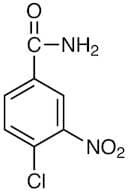
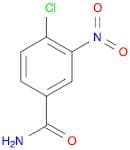
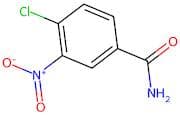
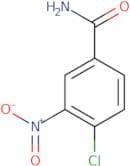
CAS 16588-06-0
:4-Chloro-3-nitrobenzamide
- 3-Nitro-4-chlorobenzamide
- 4-Chlor-3-nitrobenzamid
- 4-Chlor-3-nitrobenzamid [Czech]
- Benzamide, 4-chloro-3-nitro-
- Brn 0645210
- Nsc 127825
- 4-Chloro-3-nitrobenzamide
4-Chloro-3-nitrobenzamide
CAS:Formula:C7H5ClN2O3Purity:>98.0%(GC)Color and Shape:White to Yellow powder to crystalMolecular weight:200.58Benzamide, 4-chloro-3-nitro-
CAS:Formula:C7H5ClN2O3Purity:98%Color and Shape:SolidMolecular weight:200.57924-Chloro-3-nitrobenzamide
CAS:4-Chloro-3-nitrobenzamide (4CNBA) is a potent inducer of hepatic drug metabolizing enzymes. It reacts with methyl cinnamate to form the 4-chloro-3-nitrobenzamide methyl ester and chloride ions. This reaction is catalyzed by copper, which binds to the 4CNBA molecule. The chloride ion then displaces water from the ester, producing a nitroso intermediate. This intermediate breaks down into an unstable nitrite, which in turn reacts with hydrogen peroxide to form a hydroxylamine intermediate. Hydroxylamine can then react with sulfhydryl groups to produce reactive thiols that are responsible for the induction of detoxification enzymes in the liver.
4CNBA has been shown to be toxic at high concentrations and is rapidly detoxified by Phase II enzymes such as glutathione S transferase, UDP glucuronosyltransferase, and N-acetylFormula:C7H5ClN2O3Purity:Min. 95%Color and Shape:PowderMolecular weight:200.58 g/mol