CAS 166196-73-2
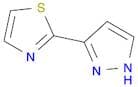
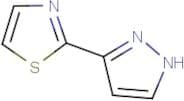
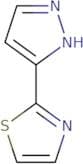
:2-(1H-pyrazol-5-yl)-1,3-thiazole
Description:
2-(1H-pyrazol-5-yl)-1,3-thiazole is a heterocyclic compound characterized by the presence of both pyrazole and thiazole rings in its structure. The pyrazole moiety contributes to its potential biological activity, often associated with various pharmacological properties, while the thiazole ring enhances its chemical reactivity and solubility. This compound typically exhibits a moderate to high polarity due to the presence of nitrogen and sulfur atoms, which can influence its interactions in biological systems. It may also display interesting optical properties, making it useful in various applications, including medicinal chemistry and material science. The compound's reactivity can be attributed to the presence of functional groups that allow for further derivatization, potentially leading to the development of novel therapeutic agents. Additionally, its stability under standard laboratory conditions makes it suitable for various synthetic applications. Overall, 2-(1H-pyrazol-5-yl)-1,3-thiazole is a versatile compound with significant implications in research and development within the fields of chemistry and pharmacology.
Formula:C6H5N3S
InChI:InChI=1/C6H5N3S/c1-2-8-9-5(1)6-7-3-4-10-6/h1-4H,(H,8,9)
SMILES:c1c[nH]nc1c1nccs1
Synonyms:- Thiazole, 2-(1H-pyrazol-3-yl)-
Sort by
Purity (%)
0
100
|
0
|
50
|
90
|
95
|
100
Found 4 products.
2-(1H-Pyrazol-3-yl)-1,3-thiazole
CAS:2-(1H-Pyrazol-3-yl)-1,3-thiazolePurity:≥95%Color and Shape:SolidMolecular weight:151.19g/mol2-(1H-Pyrazol-3-yl)thiazole
CAS:2-(1H-Pyrazol-3-yl)thiazole is a crystalline polymorph of carbon disulphide. It has been shown to have anticancer activity in vitro and in vivo models, as well as antiinflammatory activity. 2-(1H-Pyrazol-3-yl)thiazole inhibits the production of reactive oxygen species by blocking the mitochondrial electron transport chain. It also has been shown to inhibit lipid biosynthesis, which may be useful for treating cirrhosis and antimicrobial agents. Molecular modeling studies have indicated that 2-(1H-Pyrazol-3-yl)thiazole binds to the soluble guanylate cyclase, preventing activation of this enzyme and inhibiting cellular proliferation.
Formula:C6H5N3SPurity:Min. 95%Molecular weight:151.19 g/molRef: 3D-RGA19673
Discontinued product