CAS 16626-02-1
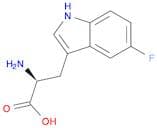
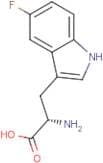
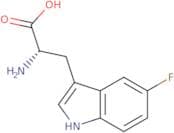
:5-fluoro-L-tryptophan
Description:
5-Fluoro-L-tryptophan is an analog of the amino acid tryptophan, where a fluorine atom is substituted at the 5-position of the indole ring. This modification can influence its biochemical properties and interactions. As a non-essential amino acid, it plays a role in protein synthesis and can be incorporated into peptides and proteins. The presence of the fluorine atom may enhance the compound's stability and alter its reactivity compared to its non-fluorinated counterpart. 5-Fluoro-L-tryptophan is often used in research to study protein structure and function, as well as in the development of pharmaceuticals, particularly in the context of neurochemistry and metabolic pathways. Its unique properties can affect enzyme activity and receptor binding, making it a valuable tool in biochemical studies. Additionally, it is important to handle this compound with care, as with any chemical substance, following appropriate safety protocols.
Formula:C11H11FN2O2
InChI:InChI=1/C11H11FN2O2/c12-14-10(11(15)16)5-7-6-13-9-4-2-1-3-8(7)9/h1-4,6,10,13-14H,5H2,(H,15,16)
SMILES:c1ccc2c(c1)c(CC(C(=O)O)NF)c[nH]2
Synonyms:- N-fluorotryptophan
Sort by
Purity (%)
0
100
|
0
|
50
|
90
|
95
|
100
Found 5 products.
L-Tryptophan, 5-fluoro-
CAS:Formula:C11H11FN2O2Purity:97%Color and Shape:SolidMolecular weight:222.2156Ref: IN-DA001WLJ
1g117.00€5g256.00€10g659.00€25gTo inquire25mg39.00€100mg40.00€250mg67.00€500mg83.00€5-Fluoro-L-tryptophan
CAS:Formula:C11H11FN2O2Purity:≥ 95.0%Color and Shape:White to off-white powderMolecular weight:222.225-Fluoro-L-tryptophan
CAS:5-Fluoro-L-tryptophan is a tryptophan analog that has been shown to inhibit the growth of resistant strains of carcinoid cells. This drug competes with tryptophan for binding to the 5HT2 receptor, which is responsible for serotonin synthesis. The fluorescence properties of this compound have been shown to change in the presence of trifluoroacetic acid and protein, suggesting that it may be used as a fluorescent probe for proteins. The structural analysis of 5-fluoro-L-tryptophan has also revealed interactions with wild-type strains that are similar to those reported for other tryptophan analogs. These interactions are thought to be steric in nature and may be due to hydrogen bonding or ionic interactions.Formula:C11H11FN2O2Purity:Min. 95%Molecular weight:222.22 g/mol(S)-2-Amino-3-(5-fluoro-1H-indol-3-yl)propanoic acid
CAS:Formula:C11H11FN2O2Purity:97%Color and Shape:SolidMolecular weight:222.219