CAS 1664-54-6
:3-(3-Aminophenyl)propionic acid
Description:
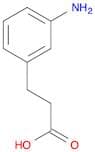
3-(3-Aminophenyl)propionic acid, also known by its CAS number 1664-54-6, is an organic compound characterized by its structure, which features a propionic acid moiety attached to a 3-aminophenyl group. This compound typically appears as a white to off-white crystalline solid and is soluble in polar solvents such as water and alcohols, owing to the presence of both the amino and carboxylic acid functional groups. It exhibits properties typical of amino acids, including the ability to participate in hydrogen bonding and act as a zwitterion under certain pH conditions. The presence of the amino group allows for potential interactions with biological systems, making it of interest in pharmaceutical and biochemical research. Additionally, its structural features may contribute to its role in various chemical reactions, including coupling reactions and as a building block in the synthesis of more complex molecules. Overall, 3-(3-Aminophenyl)propionic acid is a versatile compound with applications in medicinal chemistry and materials science.
Formula:C9H11NO2
InChI:InChI=1S/C9H11NO2/c10-8-3-1-2-7(6-8)4-5-9(11)12/h1-3,6H,4-5,10H2,(H,11,12)
InChI key:InChIKey=SBHFVSXLYOBZKD-UHFFFAOYSA-N
SMILES:C(CC(O)=O)C1=CC(N)=CC=C1
Synonyms:- 3-(2-Carboxyethyl)aniline
- 3-(3-Aminophenyl)Propanoic Acid
- 3-(3-Aminophenyl)propionic acid
- 3-Amino-3-Phenylpropanoic Acid
- 3-Aminobenzenepropanoic acid
- 3-Aminohydrocinnamic acid
- Benzenepropanoic acid, 3-amino-
- Hydrocinnamic acid, m-amino-
- β-(3-Aminophenyl)propionic acid
Sort by
Purity (%)
0
100
|
0
|
50
|
90
|
95
|
100
Found 4 products.
Benzenepropanoic acid, 3-amino-
CAS:Formula:C9H11NO2Purity:97%Color and Shape:SolidMolecular weight:165.18913-(3-Aminophenyl)propanoic acid
CAS:3-(3-Aminophenyl)propanoic acidFormula:C9H11NO2Purity:95%Color and Shape: light brown solidMolecular weight:165.19g/molβ-(3-Aminophenyl)propionic acid
CAS:Beta-(3-aminophenyl)propionic acid (BAPA) is a β-amino acid that inhibits the formation of nitric oxide and other reactive oxygen species by binding to a receptor on the surface of cells. BAPA also has inhibitory properties against certain enzymes, such as aminopyrine N-demethylase and carbonic anhydrase. It is used in analytical methods for amines, malonic acid, and hydrochloride salts. Carbon sources that are metabolized by fungi can be converted into BAPA through the process of asymmetric synthesis. This compound is also used as a precursor for gamma-aminobutyric acid (GABA), which is a neurotransmitter in the central nervous system.
Formula:C9H11NO2Purity:Min. 95%Color and Shape:PowderMolecular weight:165.19 g/mol3-(3-Aminophenyl)propionic acid
CAS:Formula:C9H11NO2Purity:95%Color and Shape:SolidMolecular weight:165.192