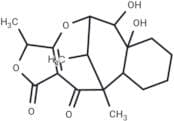
![6,6a-dihydroxy-3,11,13-trimethyl-6,6a,7,8,9,10,10a,11-octahydro-5,11-methanofuro[3,4-d][3]benzoxon…](/_next/image/?url=https%3A%2Fstatic.cymitquimica.com%2Fcas-image%2Fthumb-webp%2F397724-66a-dihydroxy-31113-trimethyl-66a-7891010a-11-octahydro-511-methanofuro-34-d-3-benzoxonine-112-3h-5h-dione.webp&w=3840&q=75)
CAS 166403-10-7
:6,6a-dihydroxy-3,11,13-trimethyl-6,6a,7,8,9,10,10a,11-octahydro-5,11-methanofuro[3,4-d][3]benzoxonine-1,12(3H,5H)-dione
Description:
The chemical substance known as 6,6a-dihydroxy-3,11,13-trimethyl-6,6a,7,8,9,10,10a,11-octahydro-5,11-methanofuro[3,4-d][3]benzoxonine-1,12(3H,5H)-dione, with CAS number 166403-10-7, is a complex organic compound characterized by its intricate polycyclic structure. It features multiple functional groups, including hydroxyl (-OH) groups and a dione moiety, which contribute to its reactivity and potential biological activity. The presence of multiple methyl groups indicates a degree of hydrophobicity, while the fused ring system suggests stability and potential for various interactions in biological systems. This compound may exhibit interesting pharmacological properties, making it a subject of interest in medicinal chemistry. Its structural complexity may also influence its solubility, melting point, and other physical properties, which are critical for applications in drug development and material science. Further studies would be necessary to elucidate its specific properties and potential uses in various fields.
Formula:C18H24O6
InChI:InChI=1/C18H24O6/c1-8-12-15(20)18(22)7-5-4-6-10(18)17(8,3)14(19)11-13(24-12)9(2)23-16(11)21/h8-10,12,15,20,22H,4-7H2,1-3H3
SMILES:CC1C2C(C3(CCCCC3C1(C)C(=O)C1=C(C(C)OC1=O)O2)O)O
Sort by
Purity (%)
0
100
|
0
|
50
|
90
|
95
|
100
Found 3 products.
Streptonolid A, Dihydrotetrodecamycin
CAS:Formula:C18H24O6Purity:89.45%Color and Shape:Greenish. Amorphous solidMolecular weight:336.0Dihydrotetrodecamycin
CAS:Dihydrotetrodecamycin, a fungal metabolite extracted from S. nashvillensis, exhibits antibacterial properties. It demonstrates activity against the fish-pathogenic bacterium P. piscicida.Formula:C18H24O6Color and Shape:SolidMolecular weight:336.38Stroptonolid A
CAS:Stroptonolid A is a natural compound, specifically classified as a polyketide. It is derived from microbial sources, often isolated from Streptomyces species which are known for their prolific production of bioactive secondary metabolites. The mode of action of Stroptonolid A involves interaction with cellular targets that can modulate biological pathways, potentially inhibiting or stimulating specific cellular processes.
Formula:C18H24O6Purity:Min. 95%Molecular weight:336.40 g/molRef: 3D-RGA40310
Discontinued product