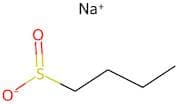
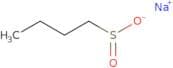
CAS 16642-95-8
:1-Butanesulfinic acid, sodium salt (1:1)
Description:
1-Butanesulfinic acid, sodium salt (1:1), with the CAS number 16642-95-8, is a chemical compound that serves as a sulfinic acid derivative. It is characterized by its sodium salt form, which enhances its solubility in water, making it useful in various applications. This compound typically appears as a white to off-white crystalline powder. It is known for its role as a reducing agent and is often utilized in organic synthesis and as a stabilizer in certain chemical processes. The presence of the sulfinic acid functional group imparts unique reactivity, allowing it to participate in various chemical reactions, including nucleophilic substitutions. Additionally, it may exhibit mild acidity due to the sulfinic acid moiety, which can influence its behavior in different pH environments. Safety data indicates that, like many chemical substances, it should be handled with care, following appropriate safety protocols to mitigate any potential hazards. Overall, 1-butanesulfinic acid, sodium salt is a versatile compound with applications in both industrial and laboratory settings.
Formula:C4H10O2S·Na
InChI:InChI=1S/C4H10O2S.Na/c1-2-3-4-7(5)6;/h2-4H2,1H3,(H,5,6);
InChI key:InChIKey=CGJUVNOIOSKGHJ-UHFFFAOYSA-N
SMILES:C(S(=O)O)CCC.[Na]
Synonyms:- 1-Butanesulfinic acid, sodium salt
- 1-Butanesulfinic acid, sodium salt (1:1)
- Sodium 1-butane sulfinate
- Sodium butylsulfinate
- Sodium butanesulfinate
Sort by
Purity (%)
0
100
|
0
|
50
|
90
|
95
|
100
Found 3 products.
N-Butanesulfinic acid sodium salt
CAS:N-Butanesulfinic acid sodium saltPurity:95%Molecular weight:144.17g/molN-Butanesulfinic acid sodium salt
CAS:Formula:C4H9NaO2SPurity:95%Color and Shape:LiquidMolecular weight:144.16Sodium butane-1-sulfinate
CAS:Sodium butane-1-sulfinate is a reagent that can be used to synthesize sulfoxides, pyrrole derivatives, and other organic compounds. It is also used as a salt form for pharmaceuticals. Sodium butane-1-sulfinate may be used to produce sulfoxides, which are often used in organic synthesis because they are both reactive and unreactive. This compound has been found to be an antagonist of the CRTH2 receptor, which is involved in the production of prostaglandins that regulate inflammation.
Formula:C4H9NaO2SPurity:Min. 95%Molecular weight:144.17 g/mol