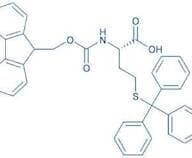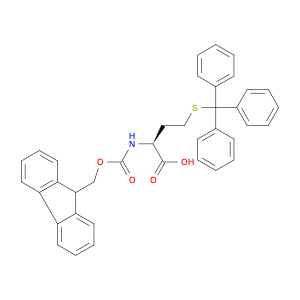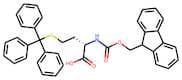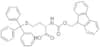
CAS 167015-23-8
:Fmoc-Homocys(Trt)-OH
Description:
Fmoc-Homocys(Trt)-OH, with the CAS number 167015-23-8, is a chemical compound commonly used in peptide synthesis and research. It is a derivative of homocysteine, an amino acid that plays a crucial role in various biological processes. The Fmoc (9-fluorenylmethoxycarbonyl) group serves as a protective group for the amino functionality, allowing for selective reactions during peptide synthesis. The Trt (trityl) group protects the thiol side chain of homocysteine, preventing unwanted reactions while facilitating the formation of peptide bonds. This compound is typically utilized in solid-phase peptide synthesis, where the stability of the protecting groups is essential for the successful assembly of peptides. Fmoc-Homocys(Trt)-OH is characterized by its ability to undergo deprotection under mild conditions, making it suitable for sequential synthesis steps. Its structural features contribute to its utility in the development of peptides with specific biological activities, including those relevant in medicinal chemistry and drug development. Overall, this compound is significant in the field of synthetic organic chemistry and biochemistry.
Formula:C38H33NO4S
Synonyms:- Fmoc-HoCys(Trt)-OH
Sort by
Purity (%)
0
100
|
0
|
50
|
90
|
95
|
100
Found 5 products.
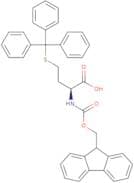
Fmoc-Homocys(Trt)-OH
CAS:Educt for the synthesis of β-turn peptidomimetics (Jiang and Burgess). Lindman et al. obtained Hcy-containing angiotensin II analogs by Fmoc-SPPS. Homocysteine can function as thiol component during chemical ligation. S-Methylation of the resulting peptide yields methionine.Formula:C38H33NO4SPurity:98.0%Color and Shape:Yellowish PowderMolecular weight:599.75Ref: IN-DA007WC3
1g68.00€5g169.00€10g201.00€25g533.00€50gTo inquire100gTo inquire250gTo inquire500gTo inquire100mg28.00€250mg40.00€S-Trityl-L-homocycteine, N-FMOC protected
CAS:S-Trityl-L-homocycteine, N-FMOC protectedPurity:99%Molecular weight:599.74g/molFmoc-S-trityl-L-homocysteine
CAS:Fmoc-S-trityl-L-homocysteine is a positron analog that can be used for the diagnosis of cancer. It is labeled with carbon-11, fluorine-18, or nitrogen-13 and can be identified by PET scanning. Fmoc-S-trityl-L-homocysteine has been shown to exhibit epidermal growth factor activity in vitro and in vivo models. This compound also helps in the diagnosis of cancer, as it binds to the surface of tumor cells and increases uptake by these cells. Fmoc-S-trityl-L-homocysteine is a congener of epidermal growth factor that may be used as a model system for other growth factors.Formula:C38H33NO4SPurity:Min. 97 Area-%Color and Shape:Off-White PowderMolecular weight:599.74 g/mol