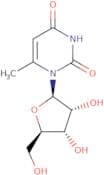
CAS 16710-13-7
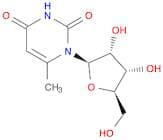
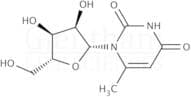
:6-methyl-1-pentofuranosylpyrimidine-2,4(1H,3H)-dione
Description:
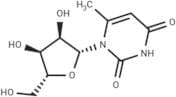
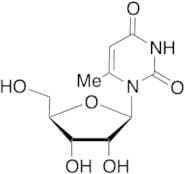
6-Methyl-1-pentofuranosylpyrimidine-2,4(1H,3H)-dione, with the CAS number 16710-13-7, is a chemical compound that belongs to the class of pyrimidine derivatives. This substance features a pyrimidine ring, which is a six-membered aromatic ring containing two nitrogen atoms at positions 1 and 3. The presence of a furanosyl group indicates that it has a five-membered sugar-like structure, contributing to its potential biological activity. The methyl group at the 6-position of the pyrimidine ring suggests that it may exhibit specific steric and electronic properties, influencing its reactivity and interactions with biological targets. As a diketone, it contains two carbonyl groups, which can participate in various chemical reactions, including condensation and nucleophilic addition. This compound may have applications in medicinal chemistry, particularly in the development of nucleoside analogs or other bioactive molecules. However, detailed studies on its pharmacological properties and mechanisms of action would be necessary to fully understand its potential uses.
Formula:C10H14N2O6
InChI:InChI=1/C10H14N2O6/c1-4-2-6(14)11-10(17)12(4)9-8(16)7(15)5(3-13)18-9/h2,5,7-9,13,15-16H,3H2,1H3,(H,11,14,17)
SMILES:Cc1cc(nc(=O)n1C1C(C(C(CO)O1)O)O)O
Sort by
Purity (%)
0
100
|
0
|
50
|
90
|
95
|
100
Found 6 products.
6-Methyluridine
CAS:Nucleosides and Reagents - 6-Modified pyrimidine nucleosideFormula:C10H14N2O6Color and Shape:SolidMolecular weight:258.23Ref: TM-TNU0134
5mgTo inquire10mgTo inquire25mgTo inquire50mgTo inquire100mgTo inquire500mgTo inquire6-Methyluridine
CAS:Controlled ProductApplications 6-Methyluridine exhibited weak antimalarial activity against P. falciparum 3D7 isolate. It is a weak substrate of Escherichia coli pyrimidine nucleoside phosphorylase.
References Bello, A., et al.: J. Med. Chem., 51, 439 (2008); Felczak, K., et al.: J. Med. Chem., 39, 1720 (1996)Formula:C10H14N2O6Color and Shape:NeatMolecular weight:258.236-Methyluridine
CAS:Methyluridine is a derivative of uridine that is used in the synthesis of pyrimidine nucleotides. This drug is also an inhibitor of orotidine 5′-monophosphate decarboxylase, which converts orotic acid to uracil. The conformational properties of methyluridine have been studied and found to be similar to those of other purine derivatives, such as adenine and guanine. In addition, methyluridine has been shown to inhibit the growth of typhimurium and increase the production of uracil in human lymphocytes. Methyluridine is metabolized by hydroxylation in liver microsomes, yielding 6-carboxylic acid.Formula:C10H14N2O6Purity:Min. 95%Color and Shape:PowderMolecular weight:258.23 g/mol