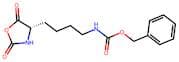
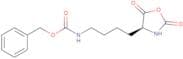
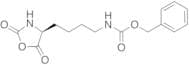
![Carbamic acid, [4-(2,5-dioxo-4-oxazolidinyl)butyl]-, phenylmethyl ester,(S)-](/_next/image/?url=https%3A%2Fstatic.cymitquimica.com%2Fcas-image%2Fthumb-webp%2F40544-n6-carbobenzoxy-l-lysine-n-carboxyanhydride.webp&w=3840&q=75)
CAS 1676-86-4
:Carbamic acid, [4-(2,5-dioxo-4-oxazolidinyl)butyl]-, phenylmethyl ester,(S)-
Description:
Carbamic acid, [4-(2,5-dioxo-4-oxazolidinyl)butyl]-, phenylmethyl ester, with the CAS number 1676-86-4, is an organic compound characterized by its carbamate functional group. This substance features a phenylmethyl ester moiety, which contributes to its potential applications in medicinal chemistry and as a synthetic intermediate. The presence of the oxazolidinone ring indicates that it may exhibit interesting biological properties, possibly related to its structural similarity to certain pharmaceuticals. The compound is likely to be a white to off-white solid, soluble in organic solvents, and may have moderate stability under standard conditions. Its reactivity can be influenced by the ester and carbamate functionalities, making it a candidate for further chemical transformations. Safety data should be consulted for handling and storage, as with any chemical substance, to ensure proper precautions are taken. Overall, this compound represents a unique structure that may be of interest in various fields, including drug development and organic synthesis.
Formula:C15H18N2O5
Synonyms:- Carbamic acid, N-[(4S)-4-(2,5-dioxo-4-oxazolidinyl)butyl]-, phenylmethyl ester
- Lys(Z)-NCA
- N-[(4S)-4-(2,5-Dioxo-4-oxazolidinyl)butyl]carbaMic Acid PhenylMethyl Ester
- L-Lys(Cbz)-NCA
- CarbaMic acid, [4-(2,5-dioxo-4-oxazolidinyl)butyl]-, phenylMethyl ester,(S)-
- (S)-[4-(2,5-Dioxo-4-oxazolidinyl)butyl]carbaMic Acid Phen
- L-[4-(2,5-Dioxo-4-oxazolidinyl)butyl]carbaMic Acid Benzyl Ester
- N-benzyloxycarbonyl-L-lysine N-carboxyanhydride
- (S)-Benzyl (4-(2,5-dioxooxazolidin-4-yl)butyl)carbamate
- Lys(Cbz)-NCA
- K(Z)-NCA
- N6-Carbobenzoxy-L-lysine N-Carboxyanhydride
- See more synonyms
Sort by
Purity (%)
0
100
|
0
|
50
|
90
|
95
|
100
Found 5 products.
N6-Benzyloxycarbonyl-L-lysine N-carboxyanhydride
CAS:Formula:C15H18N2O5Purity:96%Color and Shape:SolidMolecular weight:306.3138(S)-Benzyl (4-(2,5-Dioxooxazolidin-4-Yl)Butyl)Carbamate
CAS:(S)-Benzyl (4-(2,5-Dioxooxazolidin-4-Yl)Butyl)CarbamatePurity:97%Molecular weight:306.31g/molN6-Carbobenzoxy-L-lysine N-carboxyanhydride
CAS:N6-Carbobenzoxy-L-lysine N-carboxyanhydride is a protected form of amino acid L-lysine, where the side chain amine is Z-protected and the α-amine and carboxylic acid groups are linked via a carboxyl. N6-Carbobenzoxy-L-lysine N-carboxyanhydride can undergo a basic polycondensation reaction to afford polylysine, a polymer of α-linked lysine. Polylysine has a range of biological activities, such as, the inhibition of fungal infections (Trichophyton mentagrophytes, T. rubrum, and Candida albicans) in plants. Polylysine is used to coat tissue culture ware, where it enhances cell adherence.Formula:C15H18N2O5Purity:Min. 95%Color and Shape:White Off-White PowderMolecular weight:306.31 g/mol(S)-Benzyl (4-(2,5-dioxooxazolidin-4-yl)butyl)carbamate
CAS:Formula:C15H18N2O5Purity:96%Molecular weight:306.318N6-Carbobenzoxy-L-lysine N-Carboxyanhydride
CAS:Controlled ProductApplications A L-lysine derivative used in the preparation of Polylysine, a synthetic, basic poly-α-amino acid. Polylysine inhibited fungal penetration and polyphenol formation in susceptible sweet potatoes infected with C. fimbriata and caused some inhibition of fungal growth, a lessening of the penetration by the fungus, and more callus formation in resistant sweet potatoes. The compound inhibited the infection of tomato cuttings by F. lycopersici but was also toxic to the plants. Polyglutamic acid had no effect on the fungi in vitro.
References Buchanan-Davidson, D.J., et al.: Science, 132, 1664 (1960),Formula:C15H18N2O5Color and Shape:NeatMolecular weight:306.31