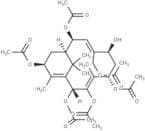
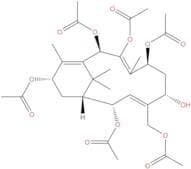
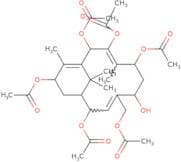
![Bicyclo[9.3.1]pentadeca-3,8,14-triene-2,3,5,7,10,13-hexol,8-[(acetyloxy)methyl]-4,14,15,15-tetrame…](/_next/image/?url=https%3A%2Fstatic.cymitquimica.com%2Fcas-image%2Fthumb-webp%2F400109-bicyclo-9-3-1-pentadeca-3814-triene-23571013-hexol-8-acetyloxy-methyl-4141515-tetramethyl-2351013-pentaacetate-2r-3e-5s-7s-8e-10s-11r-13s.webp&w=3840&q=75)
CAS 167906-74-3
:Bicyclo[9.3.1]pentadeca-3,8,14-triene-2,3,5,7,10,13-hexol,8-[(acetyloxy)methyl]-4,14,15,15-tetramethyl-, 2,3,5,10,13-pentaacetate,(2R,3E,5S,7S,8E,10S,11R,13S)-
Description:
Bicyclo[9.3.1]pentadeca-3,8,14-triene-2,3,5,7,10,13-hexol, 8-[(acetyloxy)methyl]-4,14,15,15-tetramethyl-, 2,3,5,10,13-pentaacetate, with CAS number 167906-74-3, is a complex organic compound characterized by its bicyclic structure and multiple functional groups. This substance features a unique arrangement of carbon atoms that forms a bicyclic framework, contributing to its rigidity and potential reactivity. The presence of multiple hydroxyl (–OH) groups indicates that it is a polyol, which can participate in hydrogen bonding, enhancing its solubility in polar solvents. The acetyl groups suggest that it may have ester functionalities, which can influence its reactivity and stability. Additionally, the specific stereochemistry denoted by the (2R,3E,5S,7S,8E,10S,11R,13S) configuration indicates the spatial arrangement of atoms, which is crucial for determining the compound's biological activity and interaction with other molecules. Overall, this compound's intricate structure and functional groups make it of interest in various fields, including organic synthesis and medicinal chemistry.
Formula:C32H44O13
Synonyms:- Bicyclo[9.3.1]pentadeca-3,8,14-triene-2,3,5,7,10,13-hexol,8-[(acetyloxy)methyl]-4,14,15,15-tetramethyl-, 2,3,5,10,13-pentaacetate,[2R-(2R*,3E,5S*,7S*,8E,10S*,11R*,13S*)]-
- (-)-Taxachitriene A
Sort by
Purity (%)
0
100
|
0
|
50
|
90
|
95
|
100
Found 3 products.
Taxachitriene A
CAS:Taxachitriene A is a natural product from the Chinese yew Taxus chinensis.Formula:C32H44O13Purity:98%Color and Shape:SolidMolecular weight:636.68Taxachitriene A
CAS:Taxachitriene A is a diterpene, which is a naturally occurring compound isolated from species of the Taxus genus. It is derived from the bark of these trees and forms part of the extensive group of bioactive molecules produced by this source. Taxachitriene A exhibits its mode of action primarily through disrupting cellular processes and inducing apoptosis in cancer cells. This mechanism involves interfering with the microtubule dynamics essential for cell division, thus leading to cell cycle arrest and subsequent cell death.Formula:C32H44O13Purity:Min. 95%Molecular weight:636.7 g/mol