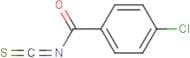
CAS 16794-67-5
:4-CHLOROBENZOYL ISOTHIOCYANATE
Description:
4-Chlorobenzoyl isothiocyanate is an organic compound characterized by its functional groups, including a benzoyl moiety and an isothiocyanate group. It typically appears as a pale yellow to light brown liquid or solid, depending on its purity and form. The presence of the chlorobenzene ring contributes to its aromatic properties, while the isothiocyanate group (-N=C=S) is known for its reactivity, particularly in nucleophilic substitution reactions. This compound is often utilized in organic synthesis, particularly in the preparation of various thioureas and other derivatives, due to its electrophilic nature. It is also of interest in biological studies, as isothiocyanates can exhibit antimicrobial and anticancer properties. Safety precautions are essential when handling this compound, as it may be harmful if inhaled or ingested, and can cause skin and eye irritation. Proper storage in a cool, dry place away from incompatible substances is recommended to maintain its stability and efficacy.
Formula:C8H4ClNOS
InChI:InChI=1/C8H4ClNOS/c9-7-3-1-6(2-4-7)8(11)10-5-12/h1-4H
SMILES:c1cc(ccc1C(=O)N=C=S)Cl
Synonyms:- P-Chlorobenzoyl Isothiocyanate
Sort by
Purity (%)
0
100
|
0
|
50
|
90
|
95
|
100
Found 4 products.
4-Chlorobenzoyl isothiocyanate
CAS:4-Chlorobenzoyl isothiocyanateFormula:C8H4ClNOSPurity:≥95%Color and Shape: solidMolecular weight:197.64g/mol4-Chlorobenzoyl isothiocyanate
CAS:Formula:C8H4ClNOSPurity:97.0%Color and Shape:SolidMolecular weight:197.644-Chlorobenzoyl isothiocyanate
CAS:4-Chlorobenzoyl isothiocyanate (4CBI) is an antibacterial agent that inhibits the growth of bacteria by binding to a molecule in the bacterial cell wall. 4CBI has been shown to inhibit the synthesis of a phytoalexin, which is a chemical compound that plants produce in response to infection or other injury. 4CBI's mode of action involves hydrogen bonding with the pyrazole ring and trisubstituted center of the molecule. This inhibition prevents formation of a reactive intermediate, which would otherwise lead to bacterial death.
Formula:C8H4ClNOSPurity:Min. 95%Molecular weight:197.64 g/mol