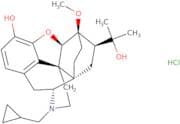
CAS 16808-86-9
:6,14-Ethenomorphinan-7-methanol, 17-(cyclopropylmethyl)-4,5-epoxy-18,19-dihydro-3-hydroxy-6-methoxy-α,α-dimethyl-, hydrochloride (1:1), (5α,7α)-
- (5alpha,7alpha)-17-(Cyclopropylmethyl)-4,5-epoxy-18,19-dihydro-3-hydroxy-6-methoxy-alpha,alpha-dimethyl-6,14-ethenomorphinan-7-methanol hydrochloride
- 6,14-Ethenomorphinan-7-methanol, 17-(cyclopropylmethyl)-4,5-epoxy-18,19-dihydro-3-hydroxy-6-methoxy-α,α-dimethyl-, hydrochloride (1:1), (5α,7α)-
- 6,14-Ethenomorphinan-7-methanol, 17-(cyclopropylmethyl)-4,5-epoxy-18,19-dihydro-3-hydroxy-6-methoxy-α,α-dimethyl-, hydrochloride, (5α,7α)-
- 6,14-Ethenomorphinan-7-methanol, 18,19-dihydro-17-(cyclopropylmethyl)-alpha,alpha-dimethyl-4,5-epoxy-3-hydroxy-6-methoxy-, hydrochloride, (5-alpha,7-alpha)-
- 6,14-endo-Ethanetetrahydrooripavine, 21-cyclopropyl-7-alpha-(1-hydroxy-1-methylethyl)-, HCl
- 6,14-endo-Ethanotetrahydrooripavine, 21-cyclopropyl-7α-(1-hydroxy-1-methylethyl)-, hydrochloride
- Diprenorphine hydrochloride
- Revivon
Diprenorphine Hydrochloride (1 mg/ml in Methanol)
CAS:Controlled ProductFormula:C26H35NO4·ClHColor and Shape:Single SolutionMolecular weight:462.02Diprenorphine-d3 Hydrochloride
CAS:Controlled ProductApplications Labelled Diprenorphine (D492100). Diprenorphine is a narcotic antagonist. Diprenorphine is closely related to Cyprenorphine.
References Blane, G.F., et al.: J. Pharm. Pharmacol., 19, 367 (1967), Grange, M., et al.: Rev. Med. Vet., 124, 899 (1973), Pert, C.B., et al.: Life Sci., 16, 1849 (1975), Duggett, N.S., et al.: Toxicol. Appl. Pharmacol., 31, 141 (1977),Formula:C26H33D3ClNO4Color and Shape:NeatMolecular weight:465.04Diprenorphine Hydrochloride
CAS:Controlled ProductApplications Diprenorphine is a narcotic antagonist. Diprenorphine is closely related to Cyprenorphine.
References Blane, G.F., et al.: J. Pharm. Pharmacol., 19, 367 (1967), Grange, M., et al.: Rev. Med. Vet., 124, 899 (1973), Pert, C.B., et al.: Life Sci., 16, 1849 (1975), Duggett, N.S., et al.: Toxicol. Appl. Pharmacol., 31, 141 (1977),Formula:C26H35NO4·ClHColor and Shape:NeatMolecular weight:462.02Diprenorphine hydrochloride
CAS:Controlled ProductDiprenorphine hydrochloride is a drug that belongs to the class of opioids. It is used as an antidote for opioid overdose and has been shown to be effective in reducing the severity of withdrawal symptoms. Diprenorphine hydrochloride has been shown to inhibit P-glycoprotein (P-gp), which is a membrane protein that transports certain substances from the brain back into the blood. This inhibition leads to increased concentrations of dopamine in the brain, which may contribute to its clinical relevance as an anti-psychotic agent. Diprenorphine hydrochloride also has binding affinity for μ-, κ-, δ-, and ν-opioid receptors, which can lead to decreased locomotor activity, antinociceptive effects, and sedation.
Formula:C26H36ClNO4Purity:Min. 95%Color and Shape:PowderMolecular weight:462.02 g/mol