CAS 16820-54-5
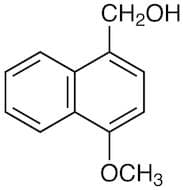
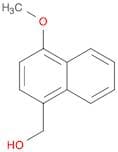
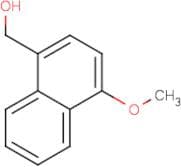
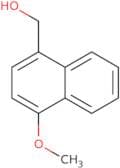
:(4-methoxynaphthalen-1-yl)methanol
Description:
(4-Methoxynaphthalen-1-yl)methanol is an organic compound characterized by its naphthalene structure substituted with a methoxy group and a hydroxymethyl group. The presence of the methoxy group enhances its solubility in organic solvents and can influence its reactivity and interaction with other molecules. This compound typically exhibits a solid state at room temperature and may have a moderate melting point, indicative of its crystalline nature. Its molecular structure suggests potential applications in organic synthesis, particularly in the development of pharmaceuticals or agrochemicals, due to the naphthalene core's ability to participate in various chemical reactions. Additionally, the hydroxymethyl group can serve as a functional handle for further chemical modifications. The compound's properties, such as polarity, boiling point, and reactivity, are influenced by the arrangement of its functional groups, making it a subject of interest in both academic and industrial research. Safety data should be consulted for handling, as with any chemical substance, to ensure proper precautions are taken.
Formula:C12H12O2
InChI:InChI=1/C12H12O2/c1-14-12-7-6-9(8-13)10-4-2-3-5-11(10)12/h2-7,13H,8H2,1H3
SMILES:COc1ccc(CO)c2ccccc12
Synonyms:- (4-Methoxy-1-naphthyl)methanol
- 1-Naphthalenemethanol, 4-Methoxy-
Sort by
Purity (%)
0
100
|
0
|
50
|
90
|
95
|
100
Found 5 products.
4-Methoxy-1-naphthalenemethanol
CAS:Formula:C12H12O2Purity:>96.0%(GC)Color and Shape:White to Light yellow to Light orange powder to crystalMolecular weight:188.231-Naphthalenemethanol, 4-methoxy-
CAS:Formula:C12H12O2Purity:97%Color and Shape:SolidMolecular weight:188.22254-Methoxy-1-naphthalenemethanol
CAS:4-Methoxy-1-naphthalenemethanolPurity:98%Molecular weight:188.22g/mol4-Methoxy-1-naphthalenemethanol
CAS:4-Methoxy-1-naphthalenemethanol is an isoenzyme of a dehydrogenase. It is found in the pancreas, tissues and human serum. 4-Methoxy-1-naphthalenemethanol has been shown to catalyze the conversion of acetaldehyde to acetate and reduces fatty acids to their corresponding hydroxy acid. This enzyme also converts ethyl esters and aldehydes into their corresponding alcohols or carboxylic acids. The reduction products are carbocations, which can be reduced by other enzymes such as thioredoxin reductase.Formula:C12H12O2Purity:Min. 95%Molecular weight:188.23 g/mol