CAS 16879-39-3
:2-Bromo-4,6-dimethylpyrimidine
Description:
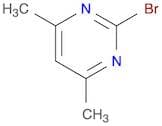
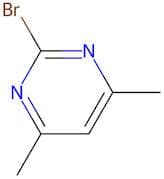
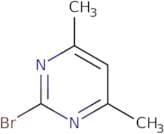
2-Bromo-4,6-dimethylpyrimidine is a heterocyclic organic compound characterized by a pyrimidine ring substituted with bromine and methyl groups. The presence of the bromine atom at the 2-position and two methyl groups at the 4 and 6 positions contributes to its unique chemical properties. This compound is typically a colorless to pale yellow liquid or solid, depending on its form and purity. It is soluble in organic solvents such as ethanol and dichloromethane but has limited solubility in water due to its hydrophobic methyl groups. 2-Bromo-4,6-dimethylpyrimidine is often used as an intermediate in organic synthesis, particularly in the pharmaceutical industry for the development of various biologically active compounds. Its reactivity is influenced by the electron-withdrawing nature of the bromine atom, which can participate in nucleophilic substitution reactions. Additionally, the compound may exhibit biological activity, making it of interest in medicinal chemistry. Proper handling and storage are essential due to its potential hazards, including toxicity and environmental impact.
Formula:C6H7BrN2
InChI:InChI=1/C6H7BrN2/c1-4-3-5(2)9-6(7)8-4/h3H,1-2H3
SMILES:Cc1cc(C)nc(Br)n1
Synonyms:- 16879-39-3
Sort by
Purity (%)
0
100
|
0
|
50
|
90
|
95
|
100
Found 4 products.
Pyrimidine, 2-bromo-4,6-dimethyl-
CAS:Formula:C6H7BrN2Purity:98%Color and Shape:SolidMolecular weight:187.03722-Bromo-4,6-dimethylpyrimidine
CAS:Formula:C6H7BrN2Purity:98%Color and Shape:SolidMolecular weight:187.042-Bromo-4,6-dimethylpyrimidine
CAS:2-Bromo-4,6-dimethylpyrimidine (2-BDMP) is a chemical compound that is synthesised by reacting acetonitrile with methylene bromide in the presence of copper. The 2-BDMP has a molecular weight of 136.22, melting point of 117°C and boiling point of 165°F. It has an ambident nature with respect to anions, which means it is soluble in water and organic solvents such as acetonitrile and tetrahydrofuran. 2-BDMP can be used as a building block for synthesising other compounds such as amidines or dioxanes. This chemical can also be used to produce yields of bromoalkyls in the presence of alkylating agents such as chloromethyl methyl ether or methanol.Formula:C6H7BrN2Purity:Min. 95%Molecular weight:187.04 g/mol